The Crossref Nominating Committee is inviting expressions of interest to join the Board of Directors of Crossref for the term starting in January 2025. The committee will gather responses from those interested and create the slate of candidates that our membership will vote on in an election in September.
Expressions of interest will be due Monday, May 27th, 2024
This is an exciting time to join the board, as we have a number of active projects underway: We are considering resourcing Crossref for a sustainable future and board members will be part of deciding any changes to our fees scheme and overseeing its implementation.
This past year has been a captivating journey of immersion within the Crossref community, a mix of online interactions and meaningful in-person experiences. From the engaging Sustainability Research and Innovation Conference in Port Elizabeth, South Africa, to the impactful webinars conducted globally, this has been more than just a professional endeavour; it has been a personal exploration of collaboration, insights, and a shared commitment to pushing the boundaries of scholarly communication.
One of the challenges that we face in Labs and Research at Crossref is that, as we prototype various tools, we need the community to be able to test them. Often, this involves asking for deposit to a different endpoint or changing the way that a platform works to incorporate a prototype.
The problem is that our community is hugely varied in its technical capacity and level of ability when it comes to modifying their platform.
When each line of code is written it is surrounded by a sea of context: who in the community this is for, what problem we’re trying to solve, what technical assumptions we’re making, what we already tried but didn’t work, how much coffee we’ve had today. All of these have an effect on the software we write.
By the time the next person looks at that code, some of that context will have evaporated.
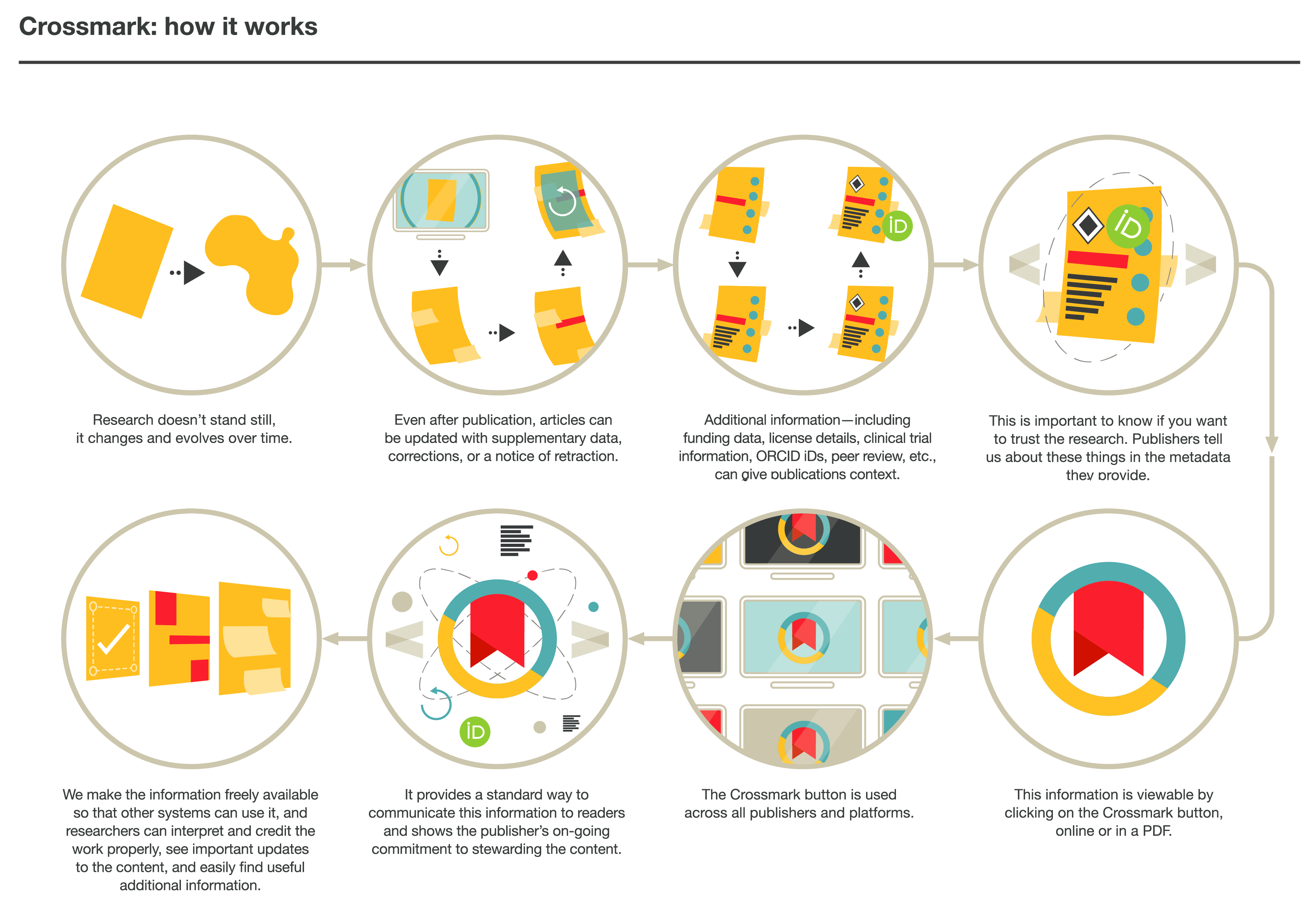
The Crossmark button gives readers quick and easy access to the current status of an item of content, including any corrections, retractions, or updates to that record.
Crossmark provides a cross-platform way for readers to quickly discover the status of a research output along with additional metadata related to the editorial process. Crucially, the Crossmark button can also be embedded in PDFs, which means that members have a way of alerting readers to changes months or even years after it’s been downloaded.
Research doesn’t stand still: even after publication, articles can be updated with supplementary data or corrections. It’s important to know if the content being cited has been updated, corrected, or retracted. Crossmark makes this information more visible to readers. With one click, you can see if content has changed, and access valuable additional metadata provided by the member, such as key publication dates (submission, revision, acceptance), plagiarism screening status, and information about licenses, handling editors, and peer review.
Crossmark lets readers know when a substantial change affecting the citation or interpretation has occurred, and that the member has updated the metadata record to reflect the new status.
Watch the introductory Crossmark animation in your language:
Members can report updates to readers and showcase additional metadata.
Researchers and librarians can easily see the changes to the content they are reading, which licenses apply to the content, see linked clinical trials, and more.
Anyone can access metadata associated with Crossmark through our REST API, providing a myriad of opportunities for integration with other systems and analysis of changes to the scholarly record.
How Crossmark works
Members place the Crossmark button close to the title of an item on their web pages and in PDFs. They commit to informing us if there is an update such as a correction or retraction, as well as optionally providing additional metadata about editorial procedures and practices.
The Crossmark button can be added to any platform that links to the content using the DOI.
While members who implement Crossmark provide links to update policies and commit themselves to accurately reporting updates, the presence of Crossmark itself is not a guarantee. However, it allows the community to more easily verify how members are updating their content.
If you use Crossmark, the Crossmark button must be applied to all of your new content, not just content is updated. Selective implementation means that a reader, such as a research or librarian, who downloaded a PDF version before the update would have no way to know that it has been updated. We also encourage you to implement Crossmark for backfile content, although doing so is optional. At least, we encourage you to do so for backfile content that has been updated.
Obligations for Crossmark
Any member can provide update metadata and we strongly encourage you to do so, in addition to registering an update policy. If you are a member who implements the Crossmark button, you must:
Maintain your content and promptly register any updates.
Include the Crossmark button on all digital formats (HTML, PDF, ePub).
Implement Crossmark using the script provided by us.
Not alter the Crossmark button in any way other than adjusting its size.
Implementing the Crossmark button involves technical changes to your website and production processes. Check that you have the necessarily expertise to implement these before you start. If not, you can start to deliver update metadata and implement the Crossmark button at a later point.
Any organisation can also implement the Crossmark button on pages where they display content. If you do so, you must follow the guidelines above, except for the first point if you are not reponsible for the content.
There are no additional fees to participate in Crossmark.
How to participate in Crossmark
There are several steps to fully implementing Crossmark for members and these can be implemented incrementally over time:
First, devise an update policy and link it to all of your metadata records. The policy statement is a page on their website, which explains their participation in the service, their commitment to maintaining versions of any record that displays the Crossmark icon, and their policies on corrections, retractions, withdrawals, and other updates.
Second, add relevant metadata about editorial processes, procedures, and updates to metadata records. This can include information about key dates in the editorial process, peer review and editor decisions, clinical trials and licensing.
Third, publish corrections and retractions for works where necessary. Guidance on updates is available.
Fourth, implement the Crossmark button online and in PDFs. This is done by including a snippet of code containing the DOI of the related content. When the button is clicked a dialog box appears that displays information taken from the metadata record.
To see which Crossref members are registering Crossmark information, visit Participation Reports. These reports give a clear picture for anyone to see the metadata Crossref has including Crossmark data.