A couple of months ago, Ludo Waltman and André Brasil raised some questions about good practices for Crossref DOI registration, asking for input from the scholarly communication community. In this post, Ludo and André reflect on the input received and discuss the approach to DOI registration that the MetaROR publish-review-curate platform is going to take.
As Crossref celebrated its 25th anniversary last year, we are highlighting some of the most active and engaged regions in our global community.
Over the past 25 years, the makeup of Crossref membership has evolved significantly; founded by a handful of large publishers, we now have more than 24,000 members representing 165 countries. Nearly two-thirds of them self-identify as universities, libraries, government agencies, foundations, scholar publishers, and research institutions.
It’s been said that Americans are unusual in tending to ask “Where do you work?” as an initial question upon introduction to a new acquaintance, indicating a perhaps unhealthy preoccupation with work as identity. But in the context of published research, “What is this author’s affiliation?” is a question of global importance that goes beyond just wanting to know the name – and perhaps prestige level – of the place a researcher works.
As Crossref membership continues to grow, finding ways to help organisations participate is an important part of our mission. Although Crossref membership is open to all organisations that produce scholarly and professional materials, cost and technical challenges can be barriers to joining for many.
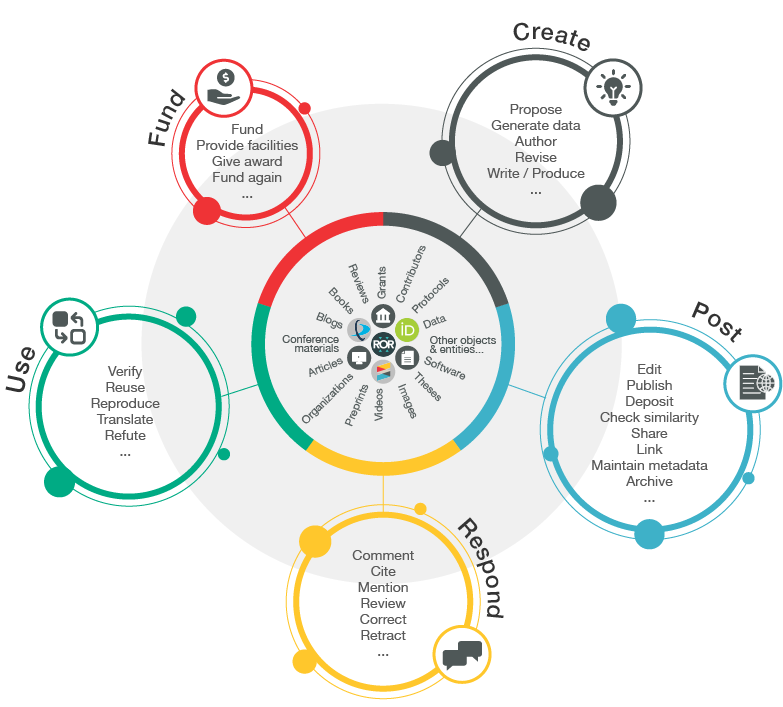
The ‘research nexus’ is the vision to which we aspire:
A rich and reusable open network of relationships connecting research organisations, people, things, and actions; a scholarly record that the global community can build on forever, for the benefit of society.
The research nexus goes beyond the basic idea of just having persistent identifiers for content. Objects and entities such as journal articles, book chapters, grants, preprints, data, software, statements, dissertations, protocols, affiliations, contributors, etc. should all be identified and that is still an important part of the picture. But what is most important is how they relate to each other and the context in which they make up the whole research ecosystem.
The foundation of the research nexus is metadata; the richer and more comprehensive the metadata in Crossref records, the more value there is for our members and for others, including for future generations.
Crossref Research Nexus Vision
Metadata and relationships between research objects and entities can support the whole scholarly research ecosystem in many ways, including:
Research integrity: helping to provide signals about the trustworthiness of the work including provenance information such as who funded it (when and for how much), which organisations and people contributed what, whether something was updated or corrected, and whether it was checked for originality. All of these signals can be expressed through Crossref metadata.
Reproducibility: helping others to reproduce outcomes by adding relationships between literature, data, software, protocols and methods, and more. All of these relationships can be asserted through members’ ongoing stewardship of their Crossref metadata records.
Reporting and assessment: helping organisations such as universities, funders, governments, to track and demonstrate the outcomes of investment; provide benchmarking information; show compliance with funder mandates; and decide what other research to fund. This kind of information can be included in Crossref metadata.
Discoverability: helping people and systems identify work through multiple angles. Registering content with Crossref makes it possible for work to be found and used. Thousands of systems use Crossref metadata, therefore the richer the records are, the more visibility there is likely to be of your work. Including metadata like abstracts and references are very simple ways to increase the visibility of your records.
The importance of relationships
A big part of the research nexus is establishing connections between and among different research objects which establishes provenance over time. Adding relationships to your metadata records can convey much richer and more nuanced connections beyond traditional references.
These relationships may consist of versions, corrections, translations, data, formats, supplements, and components. There are no extra fees for including relationships in your metadata.
What types of resources and records can be registered with Crossref?
We are working to make our input schema more flexible so that almost any type of object can be registered and distributed openly through Crossref. At the moment, members tend to register the following:
Conference proceedings: information about a single conference and records for each conference paper/proceeding.
Datasets: includes database records or collections.
Dissertations: includes single dissertations and theses, but not collections.
Grants: includes both direct funding and other types of support such as the use of equipment and facilities.
Journals and articles: at the journal title and article level, and includes supplemental materials as components.
Peer reviews: any number of reviews, reports, or comments attached to any other work that has been registered with Crossref.
Pending publications: a temporary placeholder record with minimal metadata, often used for embargoed work where a DOI needs to be shared before the full content is made available online.
Preprints and posted content: includes preprints, eprints, working papers, reports, and other types of content that has been posted but not formally published.