Crossref members register around 37,000 records daily. All this metadata is openly shared with the global scholarly community through our free APIs. We receive over two billion calls to our API each month, signalling its use by hundreds of tools and services worldwide, supporting the discovery and assessment of scholarly metadata. As part of a new series in our blog, we will spotlight the diversity of tools and integrations that rely on Crossref metadata to serve the scholarly community. In this initial post, we chat to Luca Foppiano, the developer and maintainer of Grobid1, to learn about how Grobid uses Crossref metadata to improve the extraction and enrichment of bibliographic information from scholarly PDFs.
On behalf of the Nominating Committee, I’m pleased to share the slate of candidates for the 2026 board election. Every active member organisation is invited to submit a ballot to elect the incoming board class.
We’re providing a summary of the board’s July 2026 meeting. The July board meeting is our only in-person meeting. The board gathers for two days of strategic thinking and long-range planning, as well as conducting annual board business. This year, we focused on allocating surplus funds we have on hand to invest in a three-year project to redesign the content system. In a related discussion, we decided to lower content registration fees starting in 2027 because we’ve had a demonstrated history of generating surpluses, exceeding what we need to run Crossref. We also discussed the board structure, as part of our regular review of stakeholder governance. And we conducted annual board business, such as approving the audited financial statements and reviewed our risk register and mitigation plans.
The resolutions are available on the dedicated section of our website, which also lists the members of the Board and offers further information about our governance.
We also managed to squeeze in watching a World Cup game over dinner.
Starting today, funder names deposited in Crossref metadata without an identifier will be matched to ROR IDs, to support an open and connected Research Nexus. Funding information is an increasingly important part of the scholarly record. The improved matching strategy supports researchers, funders, institutions, and meta-researchers, who rely on that information to understand how research is supported and what outcomes that support produces.
It can be a pain when companies rebrand as it usually requires some coordinated updating of wording and logos on websites, handouts, and slides. Nevermind changing habits and remembering to use the new names verbally in presentations.
Why bother?
As our infrastructure and services expanded, we sometimes branded services with no reference to Crossref. As explained in our The Logo Has Landed post last November, this has led to confusion, and it was not scalable nor sustainable.
With a cohesive approach to naming and branding, the benefits of changing to (some) new names and logos should help everyone. Our aim is to stem confusion and be in a much better position to provide clear messages and useful resources so that people don’t have to try hard to understand what Crossref enables them to do.
So while it may be a bit of a pain short-term, it will be worth it!
What are the new names?
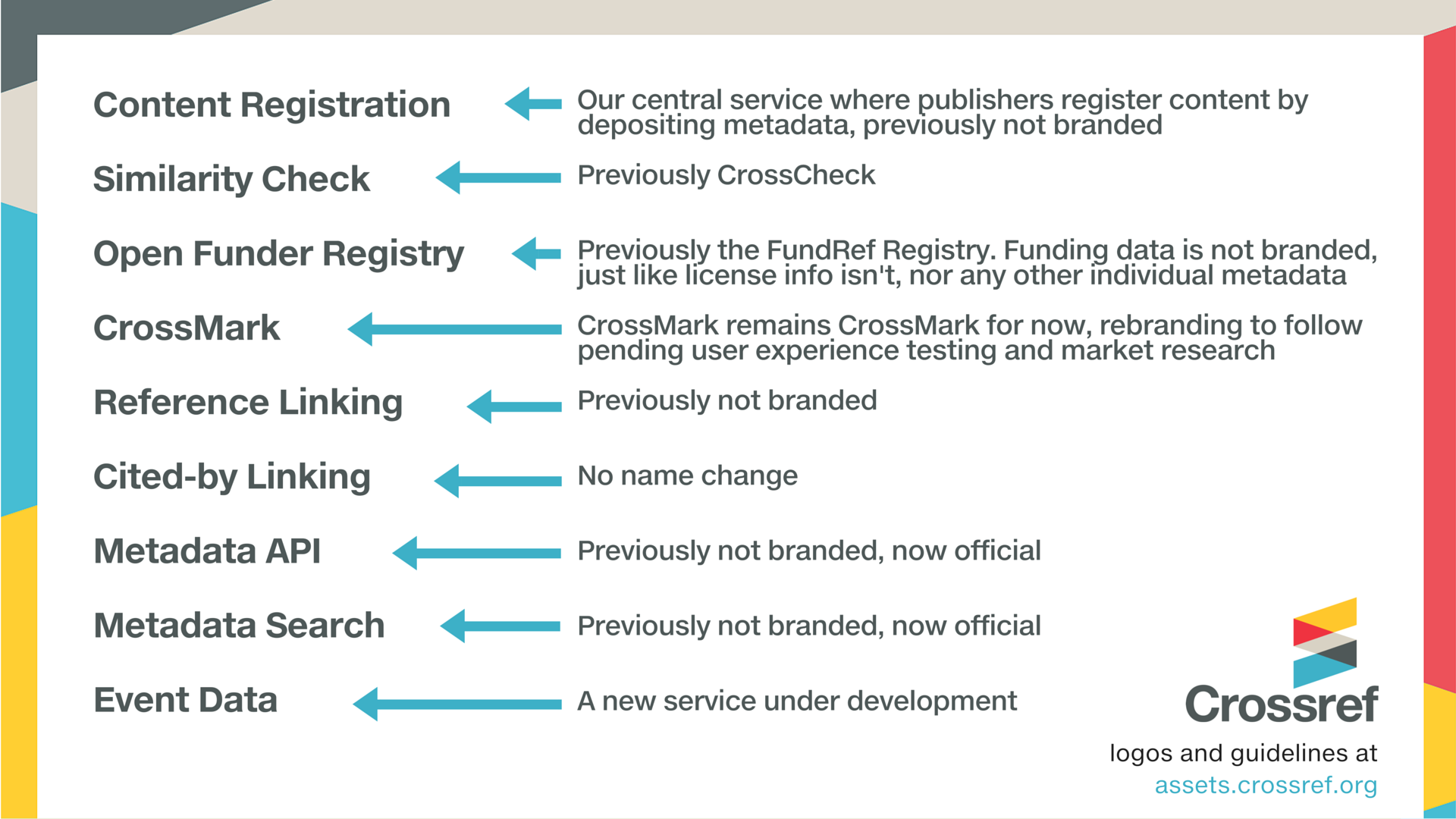
As a handy reference, here is a slide-shaped image giving an overview of our services with their new names:
Overview of brand name changes, April 2016
It’s a lowercase ‘r’ in Crossref
That’s right, you’ve spent fifteen years learning to capitalize the second R in Crossref, and now we’re asking you to lowercase it! Please say hello to and start to embrace the more natural and contemporary Crossref.
I’m hoping we can count on our community to update logos and names on your end, keeping consistent with new brand guidelines. And I hope we can make it as easy as possible to do:
This Content Delivery Network (CDN) at assets.crossref.org allows you to reference logos using a snippet of code. Please do not copy/download the logos.
We also have a new website in development which will put support and resources front and center of the user experience. More on that in the next month or two.
By using the snippets of code provided via our new CDN at assets.crossref.org, these kind of manual updates should never be a problem in the future if the logo changes again (no plans anytime soon!).
Of course, we don’t expect people to update new logos and names immediately, there is always a period of transition. Please let us know let us know if we can help you to update your sites and materials in the coming weeks.
Also, check out the launch video, which presents five key Crossref brand messages: