Each organization in the global community of Crossref members (that’s currently over 24k organizations in 166 different countries) plays a key role in building the Research Nexus. Any opportunity we have to meet with our members in person is a highlight and a way for us to learn more from each other. The month of January saw three of us travel to Bangkok to attend the first-ever Charleston Conference organised in Asia and to meet with our growing community in Thailand.
This year, we placed a spotlight on the Latin American community, hosting the second Crossref Metadata Sprint in São Paulo, Brazil from 4 - 6 March 2026. In our first tri-lingual event, we brought together 31 participants from Argentina, Brazil, Colombia, Ecuador, and Mexico. Our goal was to foster community co-creation using the open scholarly metadata. The Sprint was an opportunity to pose questions, share ideas, collaborate on research, and propose innovative solutions that enhance the use of metadata in scholarly communication and beyond.
Read on for more details about the content of the Sprint, and the resulting projects. You can also register to join our Sprint Showcase call on 22nd April to hear directly from the team about their creations.
On 17 March 2026, we experienced an outage that affected DOI resolution for Crossref DOIs and the deposit of metadata records by Crossref members. In this summary, we outline what happened, the impact on our community, and the steps we are taking to strengthen our systems and processes as a result.
We’re excited to announce a new data citation API endpoint and are seeking your feedback. The new service makes existing data citation relationships in our metadata available, thereby surfacing this part of the research nexus. At the same time, we’ve decided that it’s time to move on from Event Data.
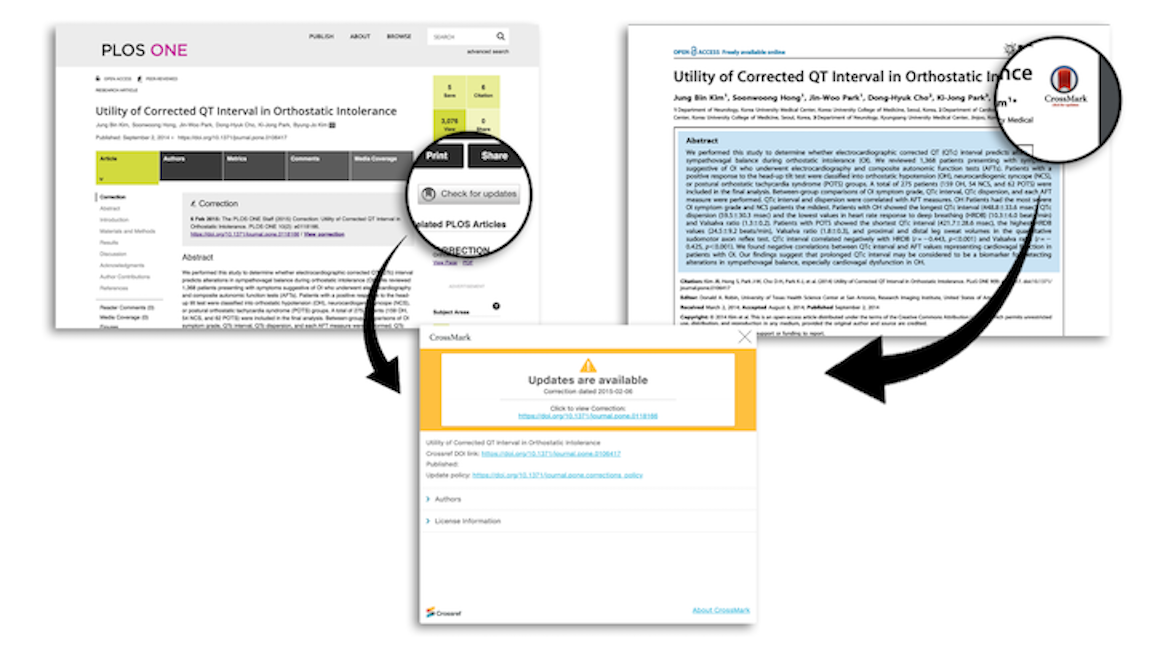
TL;DR: We no longer charge fees for members to participate in Crossmark, and we encourage all our members to register metadata about corrections and retractions - even if you can’t yet add the Crossmark button and pop-up box to your landing pages or PDFs.
–
Research doesn’t stand still; even after publication, articles can be updated with supplementary data or corrections. When research outputs are is changed in this way the publisher should report and link it, so that those accessing and citing the content know if it’s been updated, corrected or even retracted. This also emphasizes the member’s commitment to the ongoing stewardship of research outputs.
Many people find and store articles to read later, either as PDFs on their laptop or on one of any number of reference management systems - when they come back to read and cite these articles, possibly many months later, they want to know if the version they have is current or not.
Removing Crossmark fees
To encourage even wider adoption of Crossmark, and to promote best practice around better reporting of corrections and retractions, we will no longer be charging additional fees for our Crossmark service. This change applies to all Crossmark metadata registered from 1 January 2020. All members are now encouraged to add Crossmark metadata and add the Crossmark button and pop-up box to their publications - and you can do so as part of your regular content registration.
Richer metadata gives important context
We know that there are many more corrections and retractions that are not yet being registered, and to address this, we are now asking all of our members to start registering metadata for significant updates to your publications, even if you don’t implement the Crossmark button and pop-up box on your content. Remember, anyone can access the Crossmark metadata through our public REST API, and start using it straight away - even if you’re not ready to implement the Crossmark button.
Check out how to get started; if you only want to deposit metadata, follow steps one through four. If you also want to add the Crossmark button and pop-up box to your web pages/PDFs so that readers can easily see when content has changed, then also follow the rest of the steps.
Crossmark
We launched Crossmark in 2012 to raise awareness of these critical changes, by asking Crossref members to:
help readers find out about the changes by placing a Crossmark button and pop-up box (which is consistent across all members making it recognizable to readers) on your landing pages and in PDFs
Members can also use Crossmark to register additional metadata about content, giving further context and background for the reader. These metadata appear in the “More Information” section of the Crossmark box. 7 million DOIs have some additional metadata, the most common being copyright statements, publication history, and peer review methods.
Anyone can access the Crossmark metadata through our public REST API, providing a myriad of opportunities for integration with other systems, and analysis of changes to the scholarly record.
Who has implemented Crossmark?
440 Crossref members have implemented Crossmark to date. 11.4 million DOIs have some Crossmark metadata.
Total DOIs
DOIs with Crossmark metadata
%
Journal articles
80,862,460
10,155,340
12.56%
Book chapters
14,040,646
792,953
5.65%
Conference Papers
6,175,733
457,237
7.40%
Datasets
1,862,852
19,206
1.03%
Books
753,298
239
0.03%
Monographs
469,333
23
0.00%
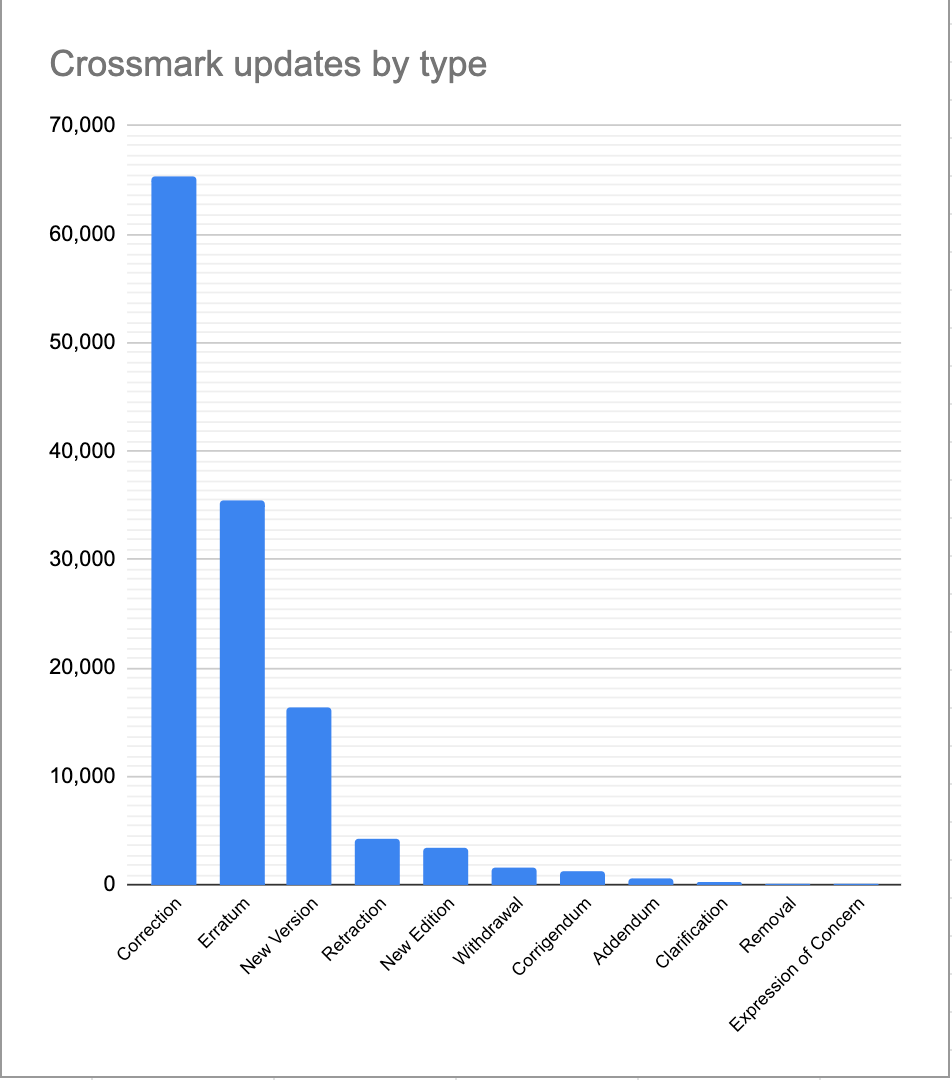
Of those, about 130,000 contain an update:
You can see which members or journals have implemented Crossmark by viewing the relevant Crossref Participation Report.