Each organization in the global community of Crossref members (that’s currently over 24k organizations in 166 different countries) plays a key role in building the Research Nexus. Any opportunity we have to meet with our members in person is a highlight and a way for us to learn more from each other. The month of January saw three of us travel to Bangkok to attend the first-ever Charleston Conference organised in Asia and to meet with our growing community in Thailand.
This year, we placed a spotlight on the Latin American community, hosting the second Crossref Metadata Sprint in São Paulo, Brazil from 4 - 6 March 2026. In our first tri-lingual event, we brought together 31 participants from Argentina, Brazil, Colombia, Ecuador, and Mexico. Our goal was to foster community co-creation using the open scholarly metadata. The Sprint was an opportunity to pose questions, share ideas, collaborate on research, and propose innovative solutions that enhance the use of metadata in scholarly communication and beyond.
Read on for more details about the content of the Sprint, and the resulting projects. You can also register to join our Sprint Showcase call on 22nd April to hear directly from the team about their creations.
On 17 March 2026, we experienced an outage that affected DOI resolution for Crossref DOIs and the deposit of metadata records by Crossref members. In this summary, we outline what happened, the impact on our community, and the steps we are taking to strengthen our systems and processes as a result.
We’re excited to announce a new data citation API endpoint and are seeking your feedback. The new service makes existing data citation relationships in our metadata available, thereby surfacing this part of the research nexus. At the same time, we’ve decided that it’s time to move on from Event Data.
Watch for two important emails on September 30th – one with a voting link and material, and one with your username and password.
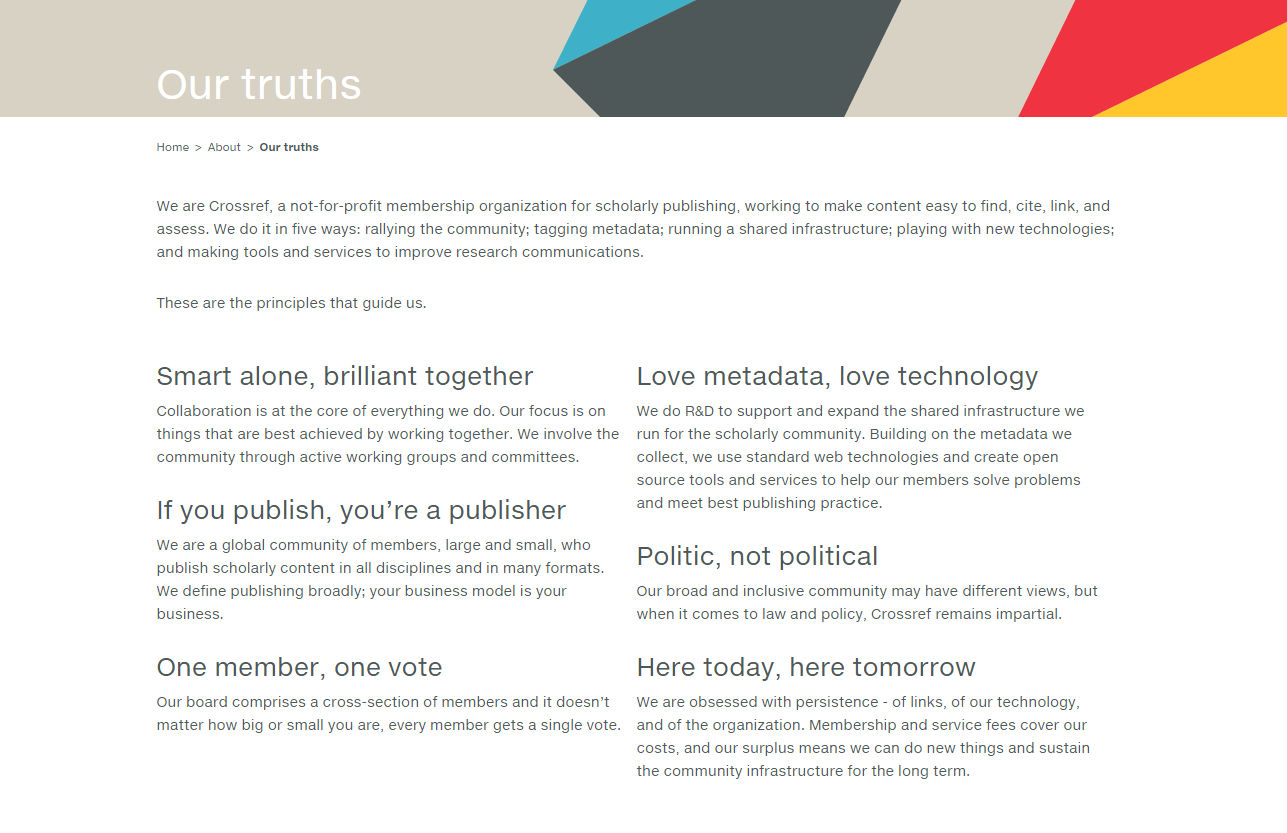
Running Crossref well is a key part of our mission. It’s important that we be as neutral and fair as possible, and we are always striving for that balance. One of our stated principles is “One member, one vote”. And each year we encourage each of our members-standing at over 6000 today-to participate in the election of new board members.
It is hard to believe that November 2nd will be Crossref’s 17th annual meeting and our 16th annual Board of Directors election. How time flies, and oh, how we have grown!
Crossref’s Truths, taken from our forthcoming new website.
I am hoping that we can rally the membership to participate in this important process!
Candidates will be elected at Crossref LIVE16 for three-year terms to fill five of the 16 Board seats whose terms expire this year. The slate of candidates was recommended by the Nominating Committee, which consisted of three Board members not up for re-election, and two Crossref members that are not on the Board.
This year, Jasper Simons, APA; Paul Peters, Hindawi; Jason Wilde, AIP; Chris Fell, Cambridge University Press; and Rebecca Lawrence, f1000 served on the Nominating Committee. The Committee met to discuss the process, criteria, and potential candidates, and put forward a slate which was required to be at least equal to the number of Board seats up for election. The slate may or may not consist of Board members up for re-election.
Crossref members are welcome to run as independent candidates, as long as they have ten member endorsements sent to lhart@crossref.org with the intent to run. We sent a notification of the process in advance (this year on August 26th), so any nominations could be included in the voting materials that will be sent via email on September 30th.