Each organization in the global community of Crossref members (that’s currently over 24k organizations in 166 different countries) plays a key role in building the Research Nexus. Any opportunity we have to meet with our members in person is a highlight and a way for us to learn more from each other. The month of January saw three of us travel to Bangkok to attend the first-ever Charleston Conference organised in Asia and to meet with our growing community in Thailand.
This year, we placed a spotlight on the Latin American community, hosting the second Crossref Metadata Sprint in São Paulo, Brazil from 4 - 6 March 2026. In our first tri-lingual event, we brought together 31 participants from Argentina, Brazil, Colombia, Ecuador, and Mexico. Our goal was to foster community co-creation using the open scholarly metadata. The Sprint was an opportunity to pose questions, share ideas, collaborate on research, and propose innovative solutions that enhance the use of metadata in scholarly communication and beyond.
Read on for more details about the content of the Sprint, and the resulting projects. You can also register to join our Sprint Showcase call on 22nd April to hear directly from the team about their creations.
On 17 March 2026, we experienced an outage that affected DOI resolution for Crossref DOIs and the deposit of metadata records by Crossref members. In this summary, we outline what happened, the impact on our community, and the steps we are taking to strengthen our systems and processes as a result.
We’re excited to announce a new data citation API endpoint and are seeking your feedback. The new service makes existing data citation relationships in our metadata available, thereby surfacing this part of the research nexus. At the same time, we’ve decided that it’s time to move on from Event Data.
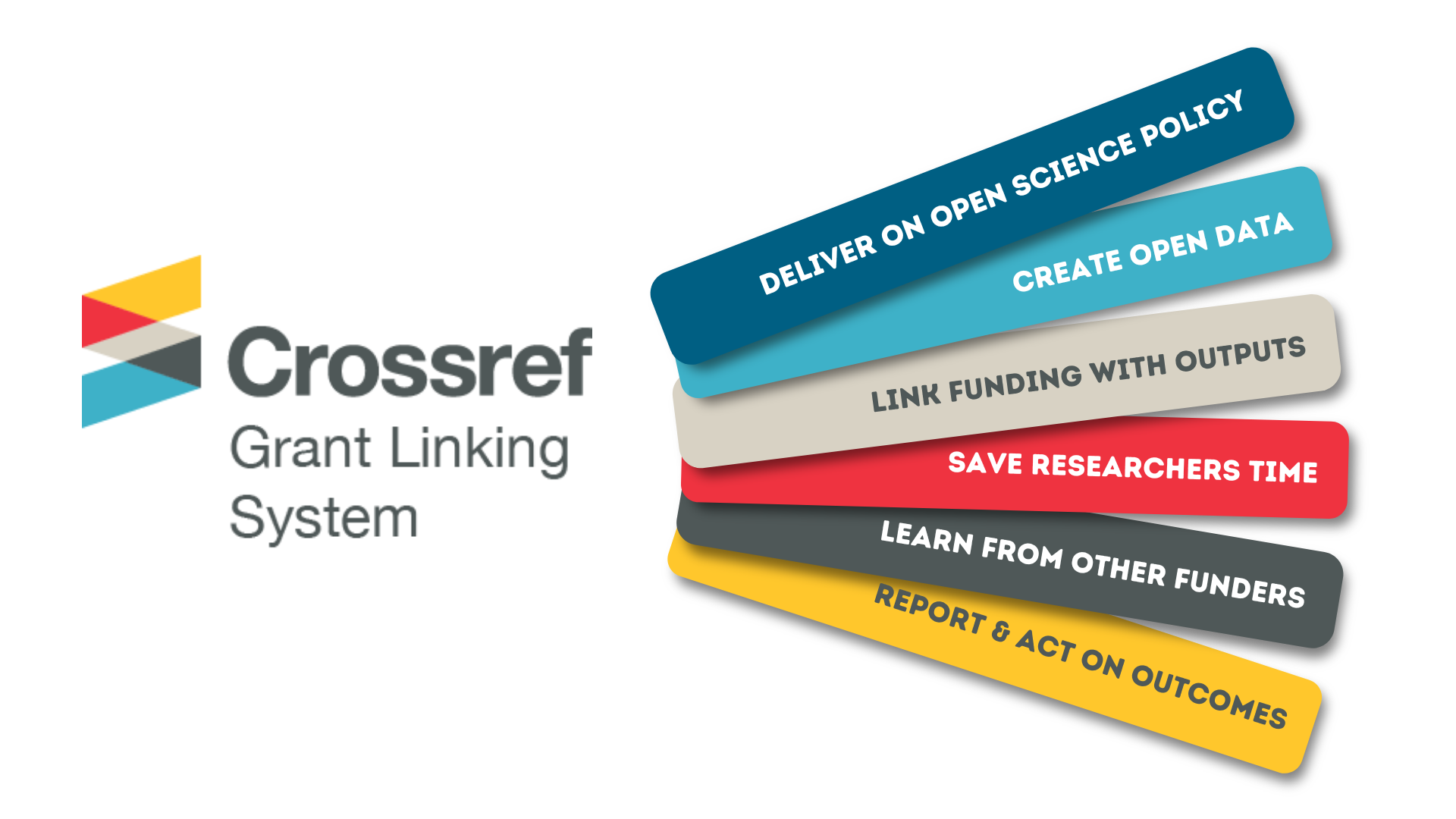
We are pleased to announce that—effective 1st January 2026—we have made two changes to grant record registration fees that aim to accelerate adoption of Crossref’s Grant Linking System (GLS) and provide a two-year window of opportunity to increase the number and availability of open persistent grant identifiers and boost the matching of relationships with research objects.
Launched in 2019 with close input from several funders and other infrastructure organisations, the GLS primarily offers the ability to create and steward Crossref Grant DOIs, along with several benefits such as dedicated grant/award metadata like funding type, value, contributors, and projects, as well as hosted landing pages, tools to create and update metadata, and of course both member-asserted and Crossref-automatic matching of relationships within the global corpus of 180 million other research objects. Essentially, we need to identify what research objects are produced as a result of the award, and these objects could be articles, preprints, data, code, blogs, posters, and more.
This connected network is what we call the Research Nexus, essential for exploring research activity in general, as well as evaluating reach and return on funding and other support like use of facilities/equipment.
Current-Year (CY) grant registration fee has been cut in half to match other record types: The board approved the adjustment of the Current-Year (CY) grant registration fee down from $2.00 to $1.00 USD, effective 1st January 2026.
Back-Year (BY) grant registration fee is waived through 2027: The board approved a time-limited fee waiver as a pilot for Back-Year (BY) grant registration fees, bringing that per-record fee down from $0.30 to $0.00 for 2026 and 2027.
We aim to boost registration of Back-Year (BY) records and accelerate the growth of the Research Nexus with millions more grant<->output matches. During the course of the two-year pilot, the Membership & Fees Committee and our fee project work that started in 2023 and also brought in other fee reductions, will consider more adjustments across BY registration fees for the benefit of members beyond just funders and beyond just grants.
Leading up to the GLS launch in 2019, we worked with a group of funders and metadata experts to inform the design and implementation of the new service, including a funder governance and fees working group. That was seven years ago, and our Funder Advisory Group now includes nearly 100 funding community representatives the GLS has grown to almost 50 funder members that have registered more than 185,000 open grant metadata records. But they are mostly research councils and agencies or charities from Europe and North America, and we know that for a truly comprehensive and interconnected Research Nexus, more needs to be done to include organisations from all parts of the world. The other key driver is simply to boost more metadata connections; the more grant metadata we gather, the better we can match it to all kinds of research outputs, and this metadata directly feeds thousands of services available in our community, from Dimensions and Scopus, to OA.Report and OpenAlex, as well as funders’ own analytics tools. See our recent report about the latest dataset and of course use api.crossref.org directly.
Relatedly, we just added a new Grant DOI field to our schema for all record types, to give our members a precise and accurate way of capturing funding metadata for all research outputs. With the new lower CY registration fee and a pilot waiver of BY fees for grant records, we hope to boost the creation of more Grant DOIs by more funders from more parts of the world—so that others also see and can build on the momentum and reuse the data in their own tools and services. All actors need to play their role, and Crossref’s part is in running the global linking infrastructure at scale, connecting research objects and making them openly available while ensuring that the barriers for the registration, use and reuse of metadata remain as low as possible.
We feel we’re at a tipping point that only needs a small nudge to truly scale the Grant Linking System.
By waiving BY fees entirely for two years, we’re hoping to see members fill in historical data and create more comprehensive grant<->outcome connections. There is often a long period of time between funding being awarded, and the resulting research objects being generated and communicated. That is why historical grant metadata is so important; we think that there will be many funding outcome relationships and insights just waiting to be uncovered!
Why give funders a fee break and not others?
We’re not ruling out this kind of fee incentive in future for other members and other object types, but that needs more analysis (which we plan to do) and right now, the relatively small number of grant records, combined with a growing need for this kind of metadata, means the changes are small enough to have almost no impact on Crossref’s healthy financial position.
This decision is consistent with the goals of our Resourcing Crossref for Future Sustainability (RCFS) to review our fees to make sure they are equitable and clear, while ensuring Crossref retains a sustainable business model. Our fees can encourage or discourage the community to participate in Crossref. The RCFS project has also resulted in the creation of a lower membership fee tier for the very lowest-resourced members, and the tidying up of things like outlier volume discounts.
The BY fee waiver is positioned as a pilot to allow us to measure its impact over the next two years and feed into the Membership & Fees Committee and RCFS project. We will evaluate the pilot results (i.e. does it indeed supercharge funding metadata connections and adoption?) and consider additional adjustments to other BY registration fees and whether such fee incentives might be extended to other members.
We encourage all funders to take advantage of these reduced rates to contribute to the Research Nexus and help us build a more complete picture of the relationship between research funding and outcomes.
Take a look at the recent case studies from early GLS adopters FWF (Austria), NWO (The Netherlands), FCCN|FCT (Portugal), and Wellcome/EuropePMC, reach out to them or us with any questions, or peruse the GLS community forum!