Crossref members register around 37,000 records daily. All this metadata is openly shared with the global scholarly community through our free APIs. We receive over two billion calls to our API each month, signalling its use by hundreds of tools and services worldwide, supporting the discovery and assessment of scholarly metadata. As part of a new series in our blog, we will spotlight the diversity of tools and integrations that rely on Crossref metadata to serve the scholarly community. In this initial post, we chat to Luca Foppiano, the developer and maintainer of Grobid1, to learn about how Grobid uses Crossref metadata to improve the extraction and enrichment of bibliographic information from scholarly PDFs.
On behalf of the Nominating Committee, I’m pleased to share the slate of candidates for the 2026 board election. Every active member organisation is invited to submit a ballot to elect the incoming board class.
We’re providing a summary of the board’s July 2026 meeting. The July board meeting is our only in-person meeting. The board gathers for two days of strategic thinking and long-range planning, as well as conducting annual board business. This year, we focused on allocating surplus funds we have on hand to invest in a three-year project to redesign the content system. In a related discussion, we decided to lower content registration fees starting in 2027 because we’ve had a demonstrated history of generating surpluses, exceeding what we need to run Crossref. We also discussed the board structure, as part of our regular review of stakeholder governance. And we conducted annual board business, such as approving the audited financial statements and reviewed our risk register and mitigation plans.
The resolutions are available on the dedicated section of our website, which also lists the members of the Board and offers further information about our governance.
We also managed to squeeze in watching a World Cup game over dinner.
Starting today, funder names deposited in Crossref metadata without an identifier will be matched to ROR IDs, to support an open and connected Research Nexus. Funding information is an increasingly important part of the scholarly record. The improved matching strategy supports researchers, funders, institutions, and meta-researchers, who rely on that information to understand how research is supported and what outcomes that support produces.
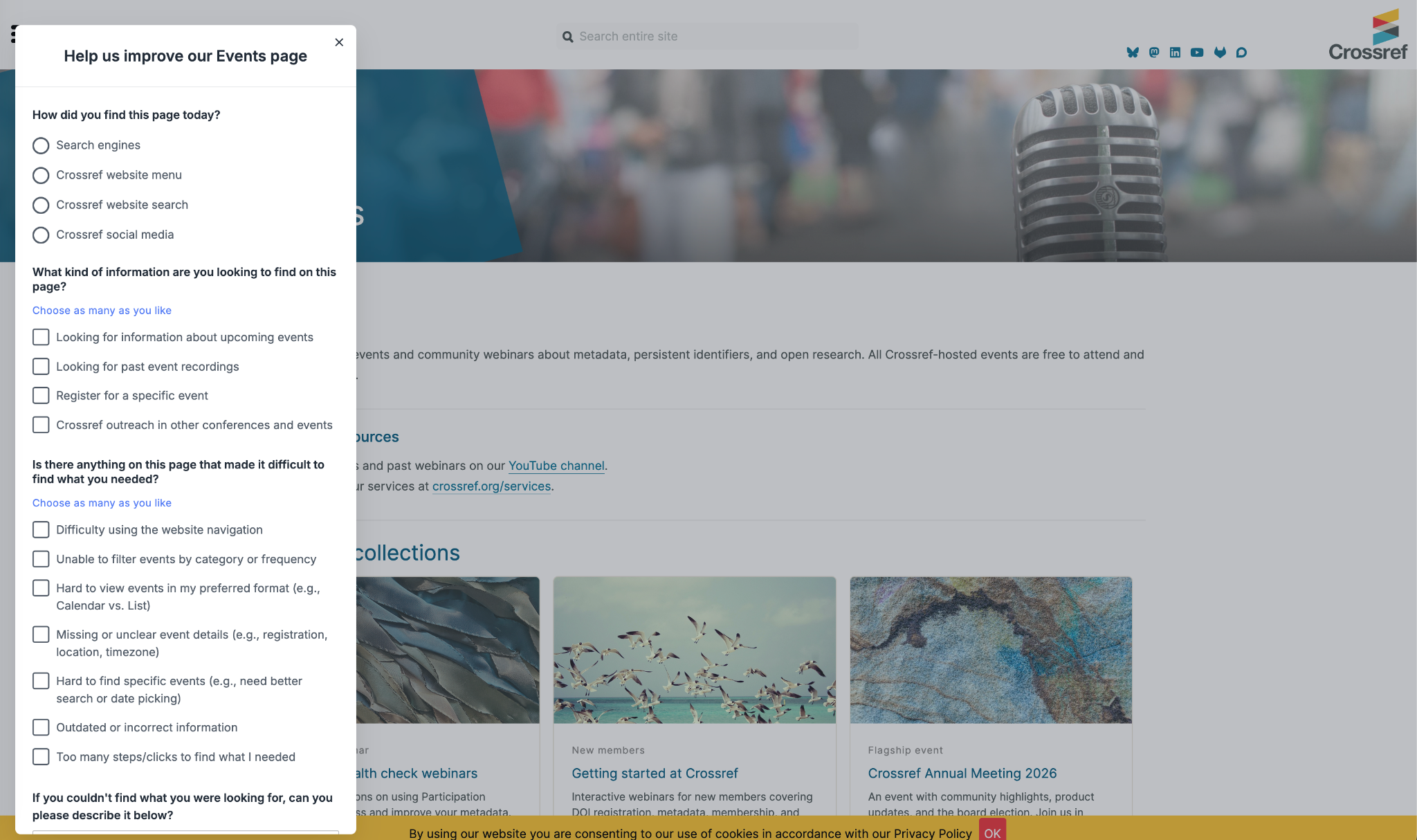
Through user experience research (UXR) initiatives that take into account our diverse membership and community, we can have a continuous, deeper understanding of the role of metadata in our members’ workflows, and ensure that our work continues to meet our community’s needs. Your support is the key to this process, and will positively impact the wider community - and if you’d like to start today, you can take part in our latest initiative: help us improve our Events page by sharing your thoughts on the page’s feedback form.
Hi, everyone! I’m Leandro Contreras, UX Researcher here at Crossref, since February 2026. In previous roles, I helped to design, build and manage digital products and workflows for universities and academic publishers, and now I’m dedicated to bridging the gap between our community’s needs and the tools we build together.
At Crossref, we’re committed to collecting diverse community input, and ensuring our system is representative and useful for everyone that interacts with it. In this blog post, I’d like to introduce you to how we’re kickstarting a more systematic approach to user research processes at Crossref, and invite you to take part in a new research initiative. First, let’s quickly revise some key concepts:
What is user experience?
User experience (UX) is the exploration of how we, as humans, interact with products and services: whether that’s a physical tool or, in our case, the invisible systems holding our metadata, or the visible interfaces that support our community - for example, our Participation Reports.
Good user experience can positively affect people’s day-to-day lives, produce quality results, and champion inclusion: we are more likely to return to a product or a service if it’s tailor-made for us, for our advantages and shortcomings.
What is user experience research?
User experience research (UXR) is the methodical study of users of a product, service or system, using methods to learn about their behaviours, needs, and preferences. While user experience is the design of the experience, UXR is the evidence-based study used to inform those designs and prove they actually work.
In practice, user experience researchers gather this evidence through a variety of methods that seek to capture quantitative and qualitative data. But what are these methods? And how do they apply in the context of an organisation like Crossref, with a growing membership building the research nexus with rich metadata using many different technologies?
How is user experience research taking shape at Crossref?
To understand the role and the impact of metadata across our vast community, we are currently mixing qualitative and quantitative research methods to help us get the right answers:
We use qualitative UX research methods to understand the why and how behind user behaviours, providing descriptive insights - interviewing our members, or observing them while using our services;
We use quantitative UX research methods to obtain measurable evidence that helps us track performance and identify patterns at scale - by sharing surveys and feedback forms with our members, or tracking success/failure metrics in unmoderated testing sessions.
In 2026, we’ve already put these methods to work:
We have collected insights to improve our current website information architecture, through surveys and usability testing at our 2026 Metadata Sprint in São Paulo;
And we conducted a series of usability testing sessions for our upcoming Book deposit flow in the new Metadata Manager tool.
Looking ahead, we’ll continue setting up usability testing sessions, open quick feedback channels on our website, and investigate the impact of research integrity across our membership through surveys. However, these initiatives are only as effective as the community behind them! When you engage in our UXR initiatives, you actively shape current and future Crossref experiences, ensuring they fit your needs.
If you are curious about participating, we’ve just launched a new feedback form on our Events page to detect new improvement opportunities, and we invite you to be part of it. This is a great opportunity to see how our initiatives work in practice, so we hope you’ll jump in!
Over time, you will see the impact of your participation come to life in future improvements to our tools and services through future project updates on our blog, and in the community forum as well. We welcome everyone to join the conversation there. If you have any further questions, suggestions, or collaboration ideas, you can also get in touch via email.
Launching new UX research initiatives at Crossref has been a wonderful way to get to know our community on a deeper level. I’m looking forward to bringing you closer to more initiatives in the future, and learning more from your feedback!
Related reading
Blog
Request for proposals: Crossref website information architecture review