Each organization in the global community of Crossref members (that’s currently over 24k organizations in 166 different countries) plays a key role in building the Research Nexus. Any opportunity we have to meet with our members in person is a highlight and a way for us to learn more from each other. The month of January saw three of us travel to Bangkok to attend the first-ever Charleston Conference organised in Asia and to meet with our growing community in Thailand.
This year, we placed a spotlight on the Latin American community, hosting the second Crossref Metadata Sprint in São Paulo, Brazil from 4 - 6 March 2026. In our first tri-lingual event, we brought together 31 participants from Argentina, Brazil, Colombia, Ecuador, and Mexico. Our goal was to foster community co-creation using the open scholarly metadata. The Sprint was an opportunity to pose questions, share ideas, collaborate on research, and propose innovative solutions that enhance the use of metadata in scholarly communication and beyond.
Read on for more details about the content of the Sprint, and the resulting projects. You can also register to join our Sprint Showcase call on 22nd April to hear directly from the team about their creations.
On 17 March 2026, we experienced an outage that affected DOI resolution for Crossref DOIs and the deposit of metadata records by Crossref members. In this summary, we outline what happened, the impact on our community, and the steps we are taking to strengthen our systems and processes as a result.
We’re excited to announce a new data citation API endpoint and are seeking your feedback. The new service makes existing data citation relationships in our metadata available, thereby surfacing this part of the research nexus. At the same time, we’ve decided that it’s time to move on from Event Data.
The rebranding of Crossref was top priority when I joined in May in a new role called “Director of Member & Community Outreach”. Since then I’ve been working to understand the array of services, attributes, and audiences we have developed; to answer the questions “What do we do, for whom, and why?”
As Crossref prepares to celebrate turning fifteen at our annual meeting next week, I am thrilled to present our new brand identity with key messages and logo. And along with “thrilled” you may also detect “nervous excitement”.
Over the last few months we have reviewed earlier research and talked with a number of members, affiliates, and academics. Turns out we’re the plain talkers of the industry, the do-ers, the scrappy people who get stuff done, chivvy others along, and in some cases we are—dare I say it—the voice of reason!
While balancing differing views within the scholarly community, we’re all about making connections – literally and figuratively. We help bring together people and metadata in pursuit of an excellent research communications system for all. And, to mirror one of Ed Pentz’s new catchphrases, we are “keeping it real”; with down-to-earth language.
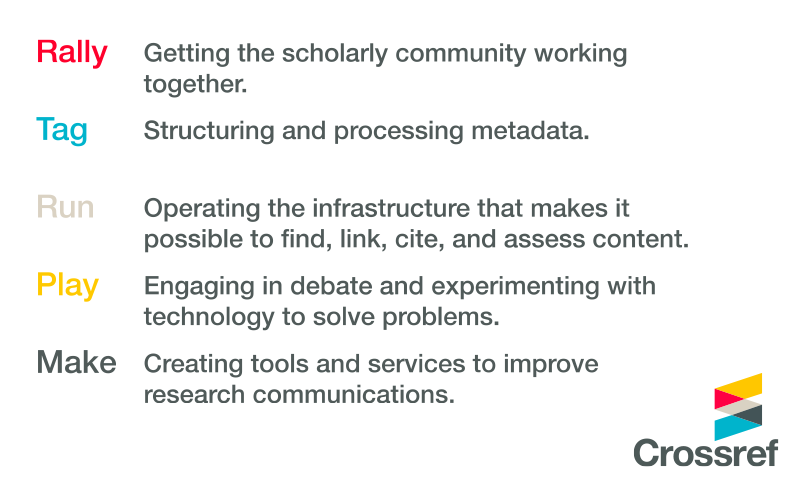
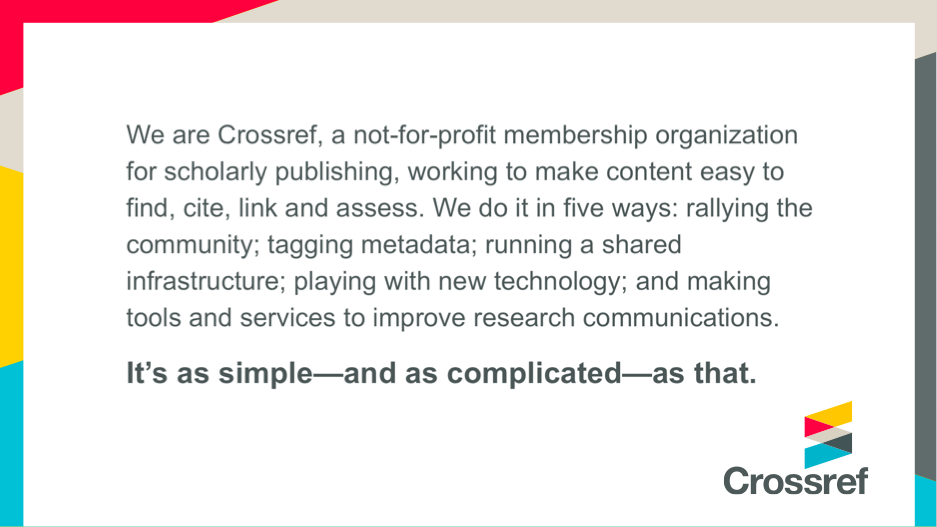
Crossref Key Messages
New logos and names for all our products will come soon (in some cases it’ll be a ‘de-brand’ rather than a re-brand!). We’ll gradually phase in the new identity over the next month or two, starting with our annual meeting, and with a complete website relaunch following in 2016. We will contact all of our members and partners in the coming weeks with information about using the new logo, using a content delivery network (CDN) so that sites can reference the correct file.
Why rebrand?
We have not rebranded because we plan on doing something different but rather to better express the things we already do. Our ‘problem’ was that often people didn’t know Crossref was behind initiatives like CrossCheck, Crossmark and FundRef. Our products had become unlinked from the organisation. And since we’re all about linking things together, that just made no sense.
We needed an icon to give more flexibility across the web that a word mark cannot do alone. The icon is made up of two interlinked angle brackets familiar to those who work with metadata, and can also act as arrows depicting Metadata In and Metadata Out, two themes under which our services can generally be grouped.
Sentence case helps to avoid splitting the word; we do not want to tempt the Cross and the Ref to divide again. So that lowercase R you see in the middle of our name is indeed an official change. (Hopefully we can change the habit!)
The palette gives a nod to the history of Crossref with red & dark grey, but brings in contemporary colors for a fresh palette that is distinctive in our industry (we researched a lot - everyone has circles, and traditional shades abound). Our aesthetic embodies classic Swiss design principles and is minimalist in keeping with our straight-talking personality.
So, in the words of Board Chair, Ian Bannerman, it’s time for Crossref to step forward.
About Crossref
I’m looking forward to revealing more of the story at our annual meeting next week!