Once a year we release all metadata records for content registered with Crossref in a public data file. This year’s version, containing nearly 180 million records, is now available. It includes metadata associated with all Crossref-registered DOIs in JSON-lines format.
Crossref Ambassadors act as local points of contact, meeting editors, librarians, researchers, and institutions to help them navigate Crossref services and understand how strong metadata supports visibility, integrity, and trust in research. They explain how to participate in our rich network of connections between works, people, and institutions, in ways that make sense in their own contexts. And last year, being our 25th anniversary, Ambassadors also massively contributed to our celebrations!
We have renewed our partnership with DOAJ to focus on a new set of objectives that reflect both organisations’ commitment to improving sustainable and equitable services and infrastructure. This renewed collaboration focuses on improving the quality of scholarly metadata while expanding support for journals in low- and middle income- countries.
We have worked together since 2021, primarily to encourage the dissemination and use of scholarly research using online technologies, and regional and international networks, partners and communities. This partnership has helped to build local institutional capacity and sustainability within the global scholarly communication ecosystem. A continued partnership also reflects that we have a shared community; currently almost 90% of DOAJ journals are represented in Crossref.
With key milestones achieved in 2025, including the appointment of new Directors of Technology and Programs, a move to the cloud, and some key schema updates, we now have a firm foundation for our next challenge: a redesign of our core technical systems to make them more modern, robust, and easier to maintain and scale.
We are pleased to announce that—effective 1st January 2026—we have made two changes to grant record registration fees that aim to accelerate adoption of Crossref’s Grant Linking System (GLS) and provide a two-year window of opportunity to increase the number and availability of open persistent grant identifiers and boost the matching of relationships with research objects.
The Crossref Board recently approved three recommendations for changes to our fees: introduction of a new lowest membership fee tier, removal of volume discounts for record registration, and normalisation of registration fees for peer reviews. The changes will be applied from January 2026.
This is the first outcome of the Resourcing Crossref for Future Sustainability (RCFS) program, launched in 2023, as a comprehensive effort to review all aspects of Crossref revenue and how we’re adapting to growth and the diversification of our membership. The program aims to make fees more equitable, simplify our complex fee schedule, and rebalance revenue sources.
We’re in year two of the Resourcing Crossref for Future Sustainability (RCFS) research. This report provides an update on progress to date, specifically on research we’ve conducted to better understand the impact of our fees and possible changes.
Crossref is in a good financial position with our current fees, which haven’t increased in 20 years. This project is seeking to future-proof our fees by:
Making fees more equitable
Simplifying our complex fee schedule
Rebalancing revenue sources
In order to review all aspects of our fees, we’ve planned five projects to look into specific aspects of our current fees that may need to change to achieve the goals above. This is an update on the research and discussions that have been underway with our Membership & Fees Committee and our Board, and what we’ve learned so far in each of these areas.
Crossref is undertaking a large program, dubbed 'RCFS' (Resourcing Crossref for Future Sustainability) that will initially tackle five specific issues with our fees. We haven’t increased any of our fees in nearly two decades, and while we’re still okay financially and do not have a revenue growth goal, we do have inclusion and simplification goals. This report from Research Consulting helped to narrow down the five priority projects for 2024-2025 around these three core goals:
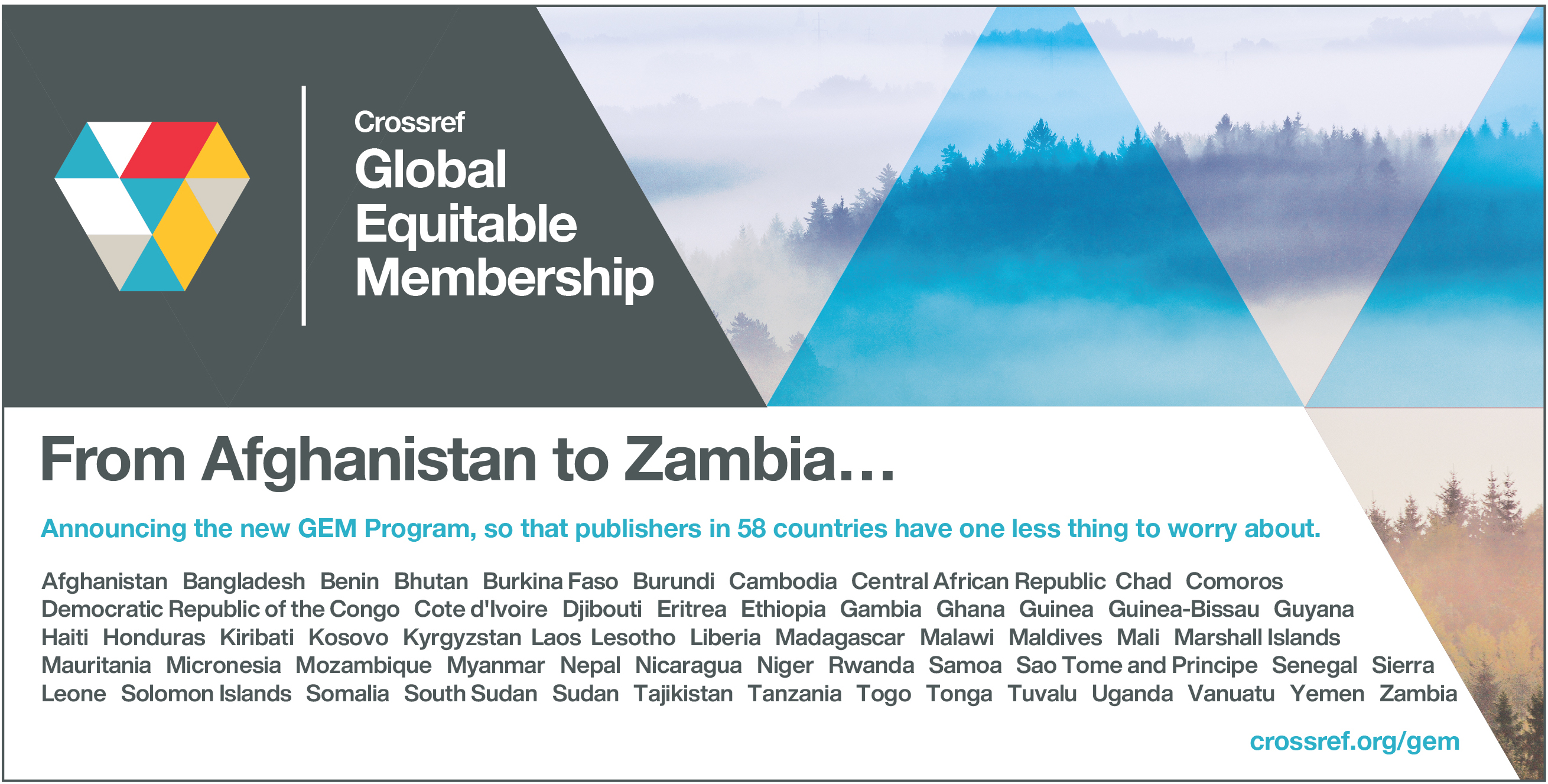
When Crossref began over 20 years ago, our members were primarily from the United States and Western Europe, but for several years our membership has been more global and diverse, growing to almost 18,000 organisations around the world, representing 148 countries.
As we continue to grow, finding ways to help organisations participate in Crossref is an important part of our mission and approach. Our goal of creating the Research Nexus—a rich and reusable open network of relationships connecting research organisations, people, things, and actions; a scholarly record that the global community can build on forever, for the benefit of society—can only be achieved by ensuring that participation in Crossref is accessible to all. Building a network for the global community must include input from all of the global community.Â