Once a year we release all metadata records for content registered with Crossref in a public data file. This year’s version, containing nearly 180 million records, is now available. It includes metadata associated with all Crossref-registered DOIs in JSON-lines format.
Crossref Ambassadors act as local points of contact, meeting editors, librarians, researchers, and institutions to help them navigate Crossref services and understand how strong metadata supports visibility, integrity, and trust in research. They explain how to participate in our rich network of connections between works, people, and institutions, in ways that make sense in their own contexts. And last year, being our 25th anniversary, Ambassadors also massively contributed to our celebrations!
We have renewed our partnership with DOAJ to focus on a new set of objectives that reflect both organisations’ commitment to improving sustainable and equitable services and infrastructure. This renewed collaboration focuses on improving the quality of scholarly metadata while expanding support for journals in low- and middle income- countries.
We have worked together since 2021, primarily to encourage the dissemination and use of scholarly research using online technologies, and regional and international networks, partners and communities. This partnership has helped to build local institutional capacity and sustainability within the global scholarly communication ecosystem. A continued partnership also reflects that we have a shared community; currently almost 90% of DOAJ journals are represented in Crossref.
With key milestones achieved in 2025, including the appointment of new Directors of Technology and Programs, a move to the cloud, and some key schema updates, we now have a firm foundation for our next challenge: a redesign of our core technical systems to make them more modern, robust, and easier to maintain and scale.
Content Registration allows members to register and update metadata via machine or human interfaces.
When you join Crossref as a member you are issued a DOI prefix. You combine this with a suffix of your choice to create a DOI, which becomes active once registered with Crossref. Content Registration allows members to register a DOI and deposit or update its associated metadata, via machine or human interfaces.
Benefits of content registration
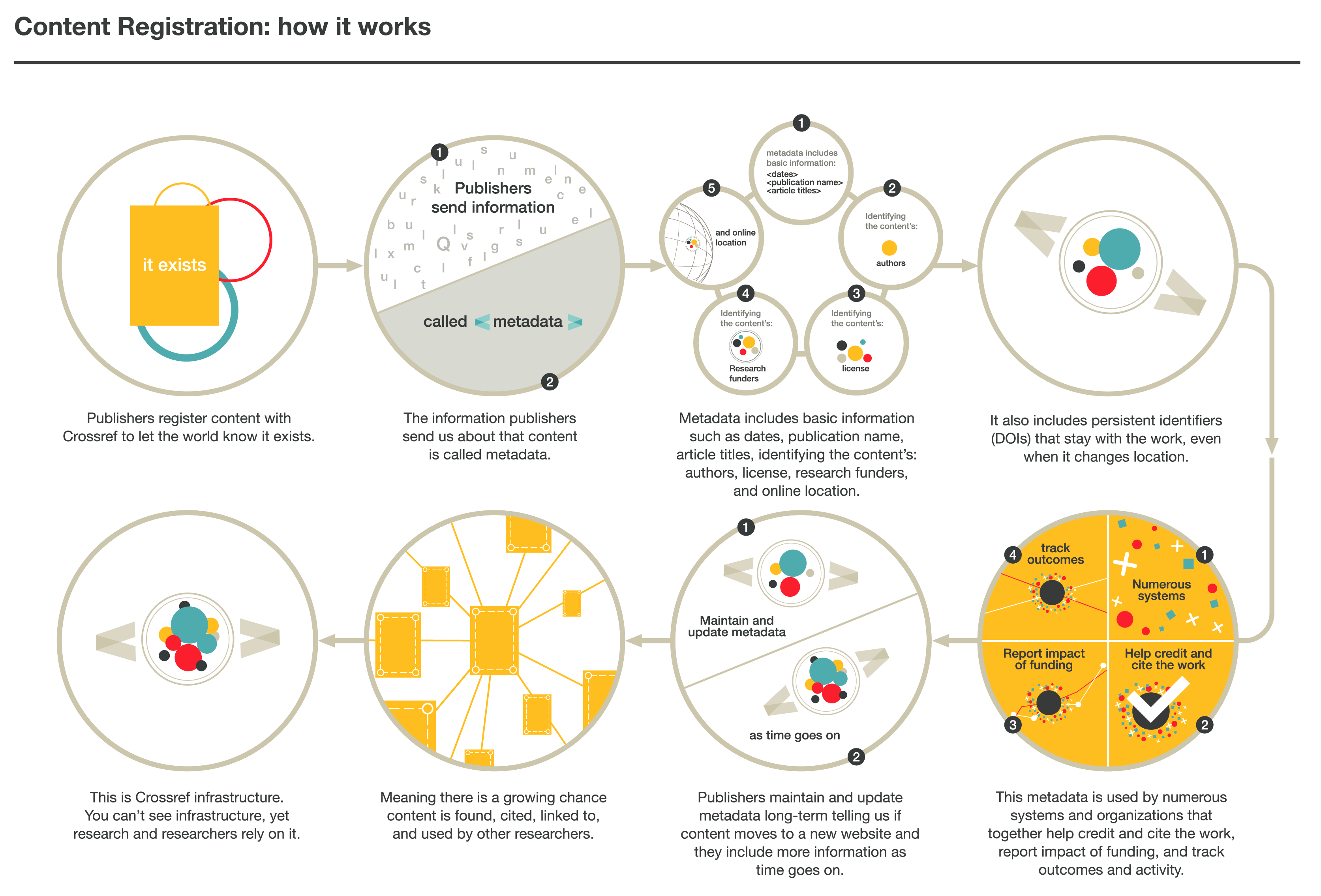
Academic and professional research travels further if it’s linked to the millions of other published papers. Crossref members register content with us to let the world know it exists, instead of creating thousands of bilateral agreements.
Members send information called metadata to us. Metadata includes fields like dates, titles, authors, affiliations, funders, and online location. Each metadata record includes a persistent identifier called a digital object identifier (DOI) that stays with the work even if it moves websites. Though the DOI doesn’t change, its associated metadata is kept up-to-date by the owner of the record.
Richer metadata makes content useful and easier to find. Through Crossref, members are distributing their metadata downstream, making it available to numerous systems and organisations that together help credit and cite the work, report impact of funding, track outcomes and activity, and more.
Members maintain and update metadata long-term, telling us if content moves to a new website, and they include more information as time goes on. This means that there is a growing chance that content is found, cited, linked to, included in assessment, and used by other researchers.
Participation Reports give a clear picture for anyone to see the metadata Crossref has. See for yourself where the gaps are, and what our members could improve upon. Understand best practice through seeing what others are doing, and learn how to level-up.
This is Crossref infrastructure. You can’t see infrastructure, yet research—and researchers all over the world—rely on it.
To register content with Crossref, you need to be a member. You’ll use one of our content registration methods to give us metadata about your content. Note that you don’t send us the content itself - you create a metadata record that links persistently (via a persistent identifier) to the content on your site or hosting platform. Learn more about metadata, constructing your DOIs, and ways to register your content.
You should assign Crossref DOIs to and register content for anything that is likely to be cited in the scholarly literature.
What types of resources and records can be registered with Crossref?
We are working to make our input schema more flexible so that almost any type of object can be registered and distributed openly through Crossref. At the moment, members tend to register the following:
Conference proceedings: information about a single conference and records for each conference paper/proceeding.
Datasets: includes database records or collections.
Dissertations: includes single dissertations and theses, but not collections.
Grants: includes both direct funding and other types of support such as the use of equipment and facilities.
Journals and articles: at the journal title and article level, and includes supplemental materials as components.
Peer reviews: any number of reviews, reports, or comments attached to any other work that has been registered with Crossref.
Pending publications: a temporary placeholder record with minimal metadata, often used for embargoed work where a DOI needs to be shared before the full content is made available online.
Preprints and posted content: includes preprints, eprints, working papers, reports, and other types of content that has been posted but not formally published.
You pay a one-time content registration fee for each content item you register with us. content registration fees are different for different types of content and sometimes include discounts for back-year material. You don’t pay to update an existing metadata record. It’s an obligation of membership that you maintain your metadata for the long term, including updating any URLs that change. In addition, we warmly encourage you to correct and add to your metadata, and there is no charge for redepositing (updating) existing metadata. Learn more about maintaining your metadata, and managing existing DOIs.
Your content registration fees are billed quarterly in arrears. This means you’ll usually receive a bill at the beginning of each quarter for the content you registered in the previous quarter. The only exception is if you’ve only registered a small number of DOIs.