Each organization in the global community of Crossref members (that’s currently over 24k organizations in 166 different countries) plays a key role in building the Research Nexus. Any opportunity we have to meet with our members in person is a highlight and a way for us to learn more from each other. The month of January saw three of us travel to Bangkok to attend the first-ever Charleston Conference organised in Asia and to meet with our growing community in Thailand.
This year, we placed a spotlight on the Latin American community, hosting the second Crossref Metadata Sprint in São Paulo, Brazil from 4 - 6 March 2026. In our first tri-lingual event, we brought together 31 participants from Argentina, Brazil, Colombia, Ecuador, and Mexico. Our goal was to foster community co-creation using the open scholarly metadata. The Sprint was an opportunity to pose questions, share ideas, collaborate on research, and propose innovative solutions that enhance the use of metadata in scholarly communication and beyond.
Read on for more details about the content of the Sprint, and the resulting projects. You can also register to join our Sprint Showcase call on 22nd April to hear directly from the team about their creations.
On 17 March 2026, we experienced an outage that affected DOI resolution for Crossref DOIs and the deposit of metadata records by Crossref members. In this summary, we outline what happened, the impact on our community, and the steps we are taking to strengthen our systems and processes as a result.
We’re excited to announce a new data citation API endpoint and are seeking your feedback. The new service makes existing data citation relationships in our metadata available, thereby surfacing this part of the research nexus. At the same time, we’ve decided that it’s time to move on from Event Data.
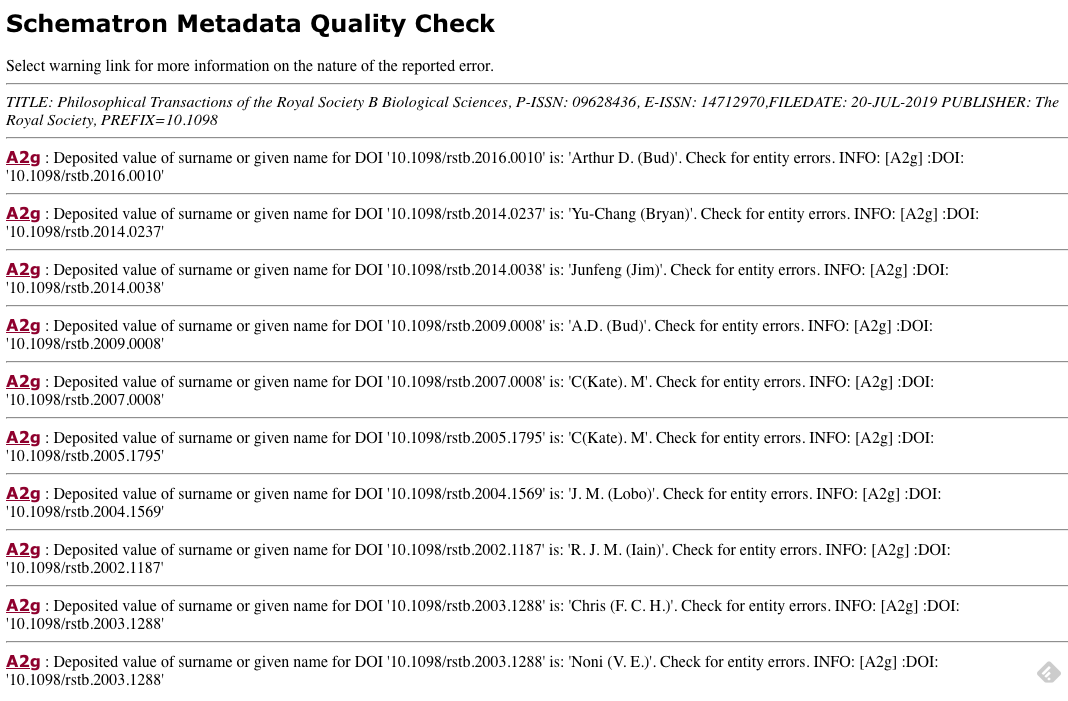
A Schematron report tells you if there’s a metadata quality issue with your records.
Schematron is a pattern-based XML validation language. We try to stop the deposit of metadata with obvious issues, but we can’t catch everything because publication practices are so varied. For example, most family names in our database that end with jr are the result of a publisher including a suffix (Jr) in a family name, but there are of course surnames ending with ‘jr’.
We do a weekly post-registration metadata quality check on all journal, book, and conference proceedings submissions, and record the results in the schematron report. If we spot a problem we’ll alert your technical contact via email. Any identified errors may affect overall metadata quality and negatively affect queries for your content. Errors are aggregated and sent out weekly via email in the schematron report.
What should I do with my schematron report?
The report contains links (organized by title) to .xml files containing error details. The XML files can be downloaded and processed programmatically, or viewed in a web browser: