Today is Global Accessibility Awareness Day, and accessibility has been on our minds lately. We’ve recently completed an internal audit of all our user interfaces, and have added a new accessibility page to our website, where you can find the accessibility documentation that we put together as part of the audit.
For a funder with over thirty years of funding history, making all of their funding metadata openly available is no small undertaking. In this conversation, I chat with Guntram Bauer, Chief Scientific Officer at the Human Frontiers Science Program (HFSP), about how the organisation is working to register decades of grant data with Crossref, the challenges of linking historical awards to published research outputs, and what open, structured funding metadata means for accountability to member countries and the wider scientific community.
We’re providing a summary of the board’s March 2026 meeting. At the meeting, the board reviewed progress in our key programs and initiatives, the strategic outlook for 2026, filled a vacancy on the Board, considered an additional legal entity for Crossref, and reviewed our governance structures. The resolutions are available on the dedicated section of our website, which also lists the members of the Board and offers further information about our governance.
In April 2025, we launched the metadata matching project, in order to add missing relationships to the scholarly metadata. We will do this by consolidating all existing and planned matching workflows, which enrich member-deposited metadata in Crossref. This unified service will result in a more complete research nexus. In this blog post, we share our latest milestone: developing and evaluating a strategy for matching funder metadata to Research Organization Registry (ROR) identifiers.
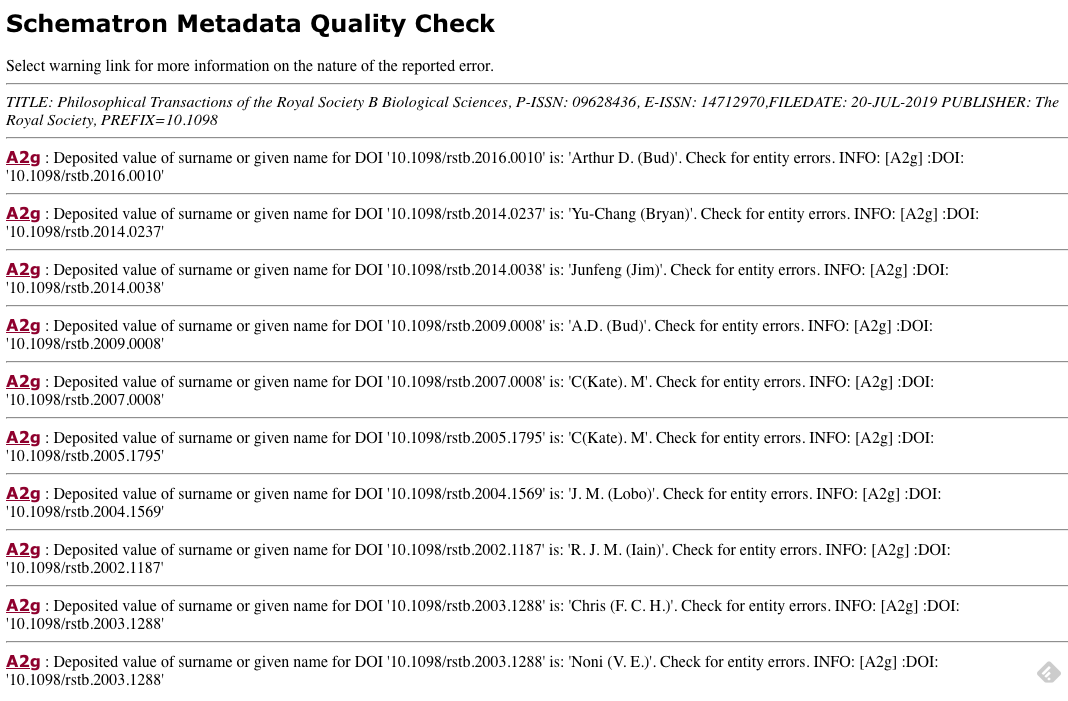
A Schematron report tells you if there’s a metadata quality issue with your records.
Schematron is a pattern-based XML validation language. We try to stop the deposit of metadata with obvious issues, but we can’t catch everything because publication practices are so varied. For example, most family names in our database that end with jr are the result of a publisher including a suffix (Jr) in a family name, but there are of course surnames ending with ‘jr’.
We do a weekly post-registration metadata quality check on all journal, book, and conference proceedings submissions, and record the results in the schematron report. If we spot a problem we’ll alert your technical contact via email. Any identified errors may affect overall metadata quality and negatively affect queries for your content. Errors are aggregated and sent out weekly via email in the schematron report.
What should I do with my schematron report?
The report contains links (organized by title) to .xml files containing error details. The XML files can be downloaded and processed programmatically, or viewed in a web browser: