Each organization in the global community of Crossref members (that’s currently over 24k organizations in 166 different countries) plays a key role in building the Research Nexus. Any opportunity we have to meet with our members in person is a highlight and a way for us to learn more from each other. The month of January saw three of us travel to Bangkok to attend the first-ever Charleston Conference organised in Asia and to meet with our growing community in Thailand.
This year, we placed a spotlight on the Latin American community, hosting the second Crossref Metadata Sprint in São Paulo, Brazil from 4 - 6 March 2026. In our first tri-lingual event, we brought together 31 participants from Argentina, Brazil, Colombia, Ecuador, and Mexico. Our goal was to foster community co-creation using the open scholarly metadata. The Sprint was an opportunity to pose questions, share ideas, collaborate on research, and propose innovative solutions that enhance the use of metadata in scholarly communication and beyond.
Read on for more details about the content of the Sprint, and the resulting projects. You can also register to join our Sprint Showcase call on 22nd April to hear directly from the team about their creations.
On 17 March 2026, we experienced an outage that affected DOI resolution for Crossref DOIs and the deposit of metadata records by Crossref members. In this summary, we outline what happened, the impact on our community, and the steps we are taking to strengthen our systems and processes as a result.
We’re excited to announce a new data citation API endpoint and are seeking your feedback. The new service makes existing data citation relationships in our metadata available, thereby surfacing this part of the research nexus. At the same time, we’ve decided that it’s time to move on from Event Data.
To work out which version you’re on, take a look at the website address that you use to access iThenticate. If you go to ithenticate.com then you are using v1. If you use a bespoke URL, https://crossref-[your member ID].turnitin.com/ then you are using iThenticate 2.0.
When your organisation signs up for Similarity Check, a central contact at your organisation will become your Similarity Check account administrator. They will set up all the users on your account.
When your administrator adds you as a user, you’ll receive an email from noreply@ithenticate.com with the subject line “Account Created” containing a username and a single-use password. You may only log in once with the single-use password, and you must change it the first time you log in.
Log in to your user account (v1)
Start from the link in the invitation email from noreply@ithenticate.com with the subject line “Account Created” and click Login
Enter your username and single-use password
Click to agree to the terms of the end-user license agreement. These terms govern your personal use of the service. They’re separate from the central Similarity Check service agreement that your organisation has agreed to.
To change your email address, remove your current address from the Email field, enter your new email in the same field, and click Update Profile to save.
To change your password, enter a new password in the Change Password field, repeat it in the Confirm Password field, and click Update Profile to save.
Find your way around for users (v1)
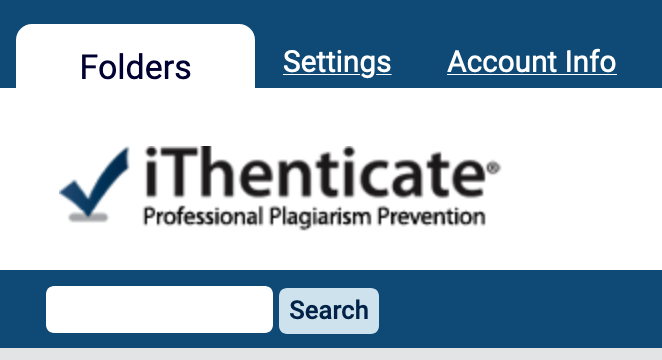
In the main navigation bar at the top of the screen, you will see several tabs:
Folders: this is the main area of iThenticate, where you upload, manage, and view documents for checking