Crossref members register around 37,000 records daily. All this metadata is openly shared with the global scholarly community through our free APIs. We receive over two billion calls to our API each month, signalling its use by hundreds of tools and services worldwide, supporting the discovery and assessment of scholarly metadata. As part of a new series in our blog, we will spotlight the diversity of tools and integrations that rely on Crossref metadata to serve the scholarly community. In this initial post, we chat to Luca Foppiano, the developer and maintainer of Grobid1, to learn about how Grobid uses Crossref metadata to improve the extraction and enrichment of bibliographic information from scholarly PDFs.
On behalf of the Nominating Committee, I’m pleased to share the slate of candidates for the 2026 board election. Every active member organisation is invited to submit a ballot to elect the incoming board class.
We’re providing a summary of the board’s July 2026 meeting. The July board meeting is our only in-person meeting. The board gathers for two days of strategic thinking and long-range planning, as well as conducting annual board business. This year, we focused on allocating surplus funds we have on hand to invest in a three-year project to redesign the content system. In a related discussion, we decided to lower content registration fees starting in 2027 because we’ve had a demonstrated history of generating surpluses, exceeding what we need to run Crossref. We also discussed the board structure, as part of our regular review of stakeholder governance. And we conducted annual board business, such as approving the audited financial statements and reviewed our risk register and mitigation plans.
The resolutions are available on the dedicated section of our website, which also lists the members of the Board and offers further information about our governance.
We also managed to squeeze in watching a World Cup game over dinner.
Starting today, funder names deposited in Crossref metadata without an identifier will be matched to ROR IDs, to support an open and connected Research Nexus. Funding information is an increasingly important part of the scholarly record. The improved matching strategy supports researchers, funders, institutions, and meta-researchers, who rely on that information to understand how research is supported and what outcomes that support produces.
Your organisation needs to be a member of Crossref in order to get a DOI prefix so you can create Crossref DOIs and register content. All members agree to our membership terms to help ensure the persistence of our infrastructure.
On this page, find out more about our membership operations:
We ask new applicants to complete an application form, and we then check that:
You meet our membership criteria and can commit to fulfil the member terms.
We are legally able to accept your organisation as a member.
Your organisation hasn’t previously been a member of Crossref whose membership was revoked.
Your organisation hasn’t misrepresented themselves in the application.
Your organisation is not already a member of Crossref.
Membership in Crossref is open to organisations that produce professional and scholarly materials and content, and we treat this broadly - “come one, come all” is one of our organisational truths. We’re a global community of members with content in all disciplines, in many formats, with all kinds of business models - research institutions, publishers, government agencies, research funders, museums and many more. But it’s important that members are able to meet the obligations of membership and work in a way which reflects our code of conduct.
As an organisation that’s based in the US (and with significant activities in the UK and Europe) there are also some legal limits on our activity - for example, we cannot accept applications for membership from organisations based in some countries due to sanctions. Find out more about sanctions which impact on Crossref membership and the countries which are affected.
We may not be able to accept applications for membership from organisations which have previously had their membership revoked or who have misrepresented themselves in their application.
And finally, if your organisation is already a member of Crossref (for example, a different department of the same university) we may add you to the existing membership. This ensure that the same organisation is not paying multiple membership fees.
Membership terms
New Crossref members agree to these member terms by ticking a box in the application form. These terms then remain in effect permanently - there is no need to renew each year. The terms will only be canceled if one of the following things happen:
If we change the Crossref membership terms, we will email the contact that each active member organisation has identified as their Primary contact (previously known as “Business contact”) to let them know about the change. This will happen no fewer than sixty days prior to effectiveness. Members may cancel their membership if they don’t want to accept the new terms.
Applications to become a sponsor
Some small organisations want to register metadata for their research and participate in Crossref but are not able to join directly due to financial, administrative, or technical barriers. Sponsors are organisations who facilitate membership for these organisations by providing administrative, billing, technical, and—if applicable—language support to these organisations. There is quite a high bar to becoming a Crossref sponsor, so not all organisations who apply will be eligible.
We send out annual membership fees (for members and sponsors) and annual subscription fees (for service providers and those subscribing to Metadata Plus or other paid-for metadata services) each January. We invoice for content registration on a quarterly basis. All invoices have a term of 45 days. We recommend that members pay using a credit or debit card through our payment portal, but other payment methods are available.
You need to contact us to cancel your membership. You aren’t able to pause your membership, so if you just stop using the service and don’t tell us that you want to cancel, we will still continue to send you annual membership fee invoices. And if you then want to start using the service again in future years, you will need to pay these outstanding membership invoices. If you actually contact us to cancel, we can stop these annual membership invoices from being created.
As an organisation that’s obsessed with persistence, we really try to avoid revoking membership. However, there are limited times when we have to. Find out more.
Membership and legal sanctions
Crossref’s mission is to support global research in and between all countries and we will always do that to the extent possible. But we are also bound by laws in the US, the UK, and the EU, and where sanctions apply we have to comply with these. Find out more
Organisations that claim to be Crossref members
Occasionally authors contact us as a publisher they are working with has claimed to be a Crossref member, or has claimed to register DOIs, but instead just displays unregistered, DOI-like strings on their website.
We don’t currently have an online list of Crossref members, and it’s the parent publishing organisation that joins Crossref (rather than individual journals), so it’s sometimes hard to work out if a journal is published by a Crossref member or not.
If you are an author planning to submit a manuscript to a publisher who claims to be a Crossref member, the best thing to do is check the DOIs that they currently display on their website.
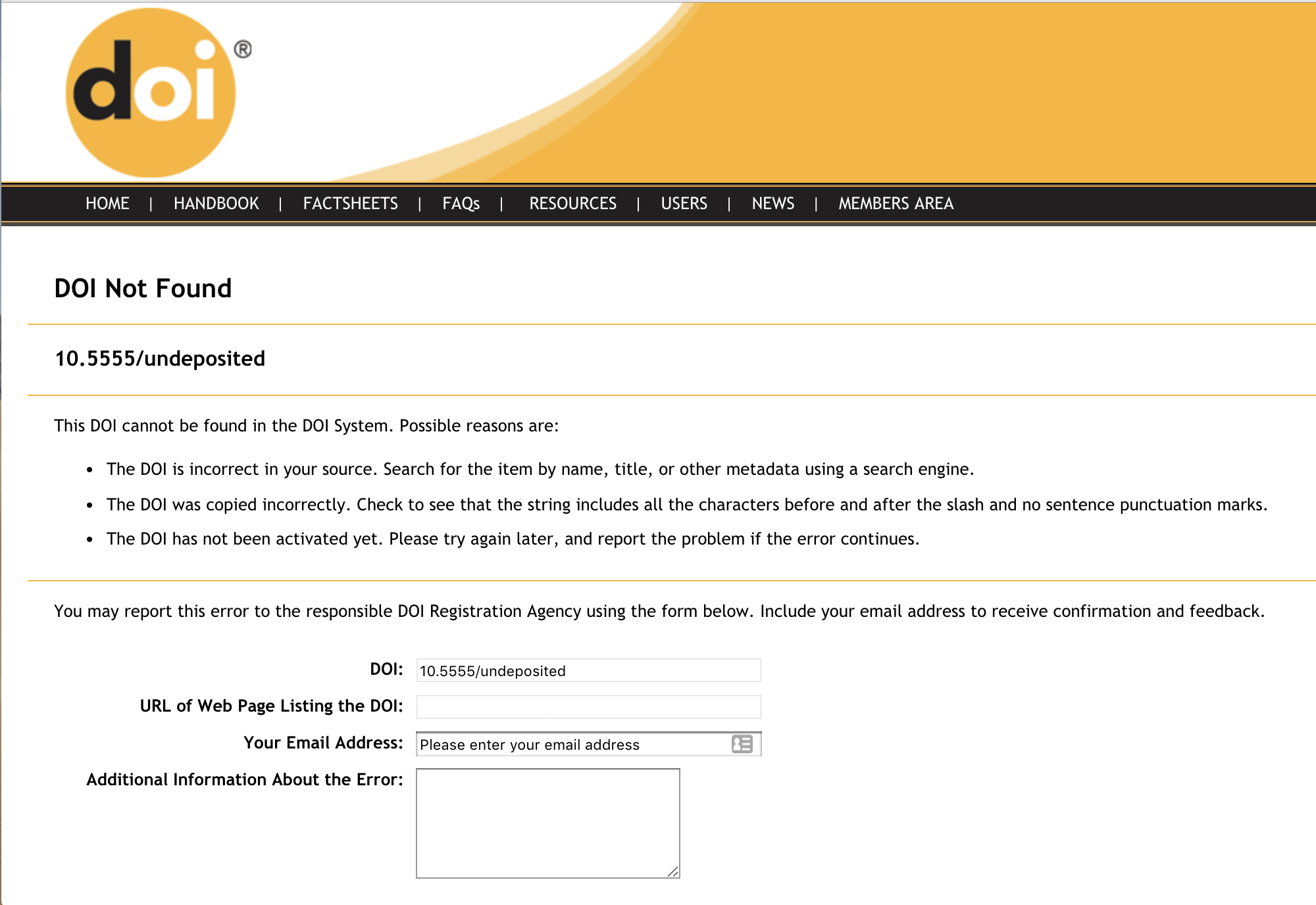
Don’t just click on the DOI link that’s displayed in the website. Instead, copy the DOI as a link, and then paste this into new tab in your browser. If the DOI resolves to an article, then that DOI has been registered with us (or with another Registration Agency), and metadata about that published item has been shared with the scholarly community through our open APIs. But if the DOI resolves to DOI Foundation Error page, then that DOI has NOT been registered, and there is no open metadata record that has been shared with the community.
For example of a DOI that has NOT been registered, copy and paste https://doi.org/10.5555/undeposited into a browser. You will arrive at the DOI Foundation Error page, rather than a scholarly work.
Always refer to the Think, Check, Submit website to help you decide whether to submit to a particular journal. If you have any problems with a publisher, do speak to your university of the team at the Committee On Publication Ethics (COPE) for support and guidance.
This is by no means comprehensive, but we do keep a list of websites where we have been informed that they are displaying fake DOIs (eg unregistered, DOI-like strings), and/or claiming to be Crossref members. (Do contact us if you are one of these organisations and have removed these fake, DOI-like strings and wish to be removed from the list).
We also hold a list of ex-members who have had their membership revoked as they contravened the membership terms.
Page maintainer: Amanda Bartell Last updated: 2022-September-13