We’re providing a summary of the board’s July 2026 meeting. The July board meeting is our only in-person meeting. The board gathers for two days of strategic thinking and long-range planning, as well as conducting annual board business. This year, we focused on allocating surplus funds we have on hand to invest in a three-year project to redesign the content system. In a related discussion, we decided to lower content registration fees starting in 2027 because we’ve had a demonstrated history of generating surpluses, exceeding what we need to run Crossref. We also discussed the board structure, as part of our regular review of stakeholder governance. And we conducted annual board business, such as approving the audited financial statements and reviewed our risk register and mitigation plans.
The resolutions are available on the dedicated section of our website, which also lists the members of the Board and offers further information about our governance.
We also managed to squeeze in watching a World Cup game over dinner.
Starting today, funder names deposited in Crossref metadata without an identifier will be matched to ROR IDs, to support an open and connected Research Nexus. Funding information is an increasingly important part of the scholarly record. The improved matching strategy supports researchers, funders, institutions, and meta-researchers, who rely on that information to understand how research is supported and what outcomes that support produces.
Strengthening Scholarly Publishing in Africa is a collaborative webinar series bringing together ASSAf, Crossref, DOAJ, EIFL, and PKP to share practical guidance, resources, and approaches for strengthening the publishing ecosystem in the region. This series responds to the growing interest in open access, digital publishing, stronger editorial practices, and greater visibility of research publishing across Africa. Each partner organisation has long experience of building that capacity in the area of their expertise. In this series, we’re coming together to offer a more holistic learning experience to the community of African publishers, putting different aspects of the publishing process in their broader context.
We’ve had a year full of growth and reached a milestone of 60+ team members; let’s take a moment to digest what that means for people operations. Hiring staff in 19+ countries is no easy task, but we are up for it, and I can honestly say it is the main reason why our culture is so great. That might sound biased coming from Crossref’s first Head of Human Resources, but hear me out.
A service provided by Crossref and powered by iThenticate—Similarity Check provides editors with a user-friendly tool to help detect plagiarism.
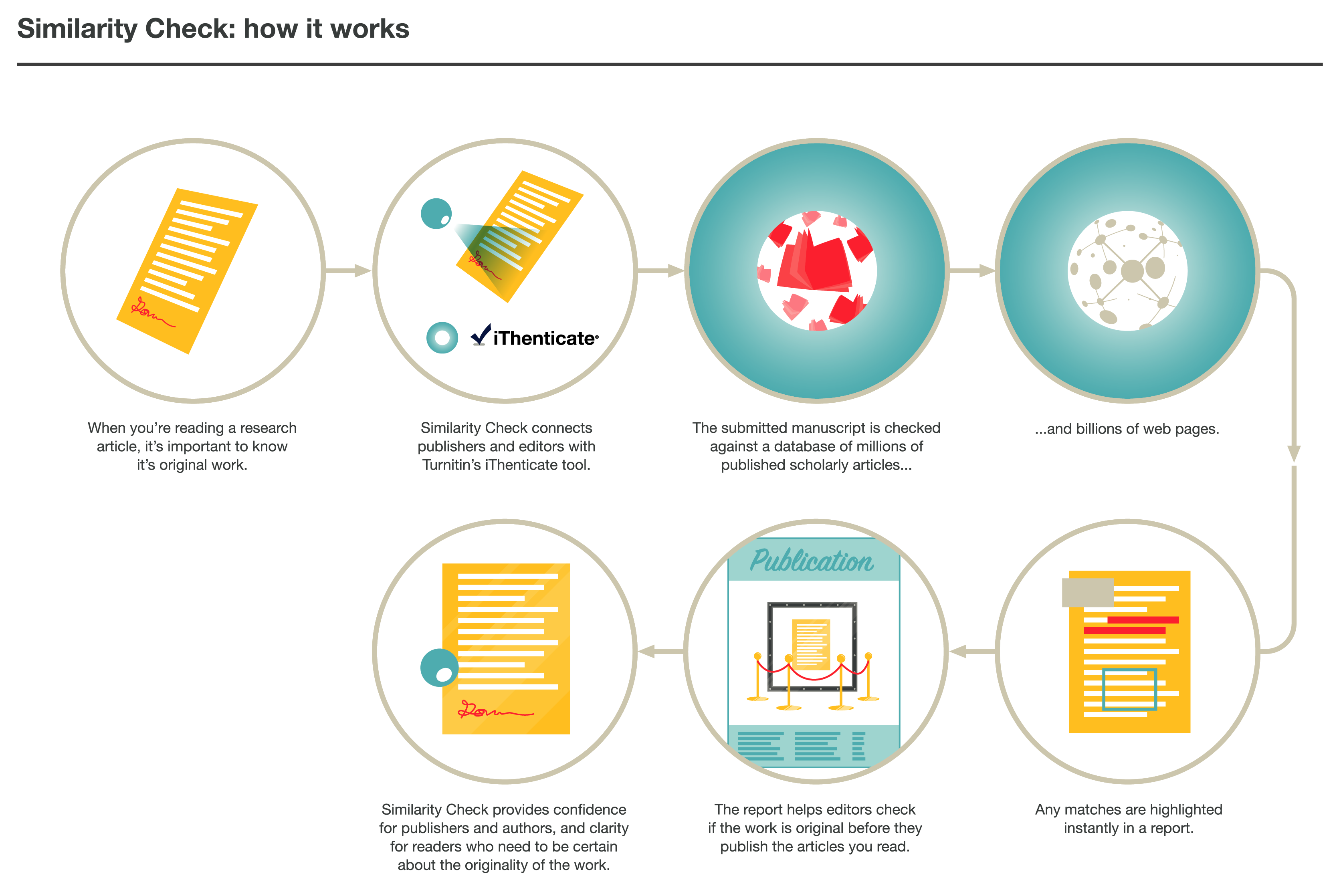
Our Similarity Check service helps Crossref members prevent scholarly and professional plagiarism by providing immediate feedback regarding a manuscript’s similarity to other published academic and general web content, through reduced-rate access to the iThenticate text comparison software from Turnitin.
Only Similarity Check members benefit from this tailored iThenticate experience that includes read-only access to the full text of articles in the Similarity Check database for comparison purposes, discounted checking fees, and unlimited user accounts per organisation.
Watch the introductory Similarity Check animation in your language:
With editors under increased pressure to assess higher volumes of manuscript submissions each year, it’s important to find a fast, cost-effective solution that can be embedded into your publishing workflows. Similarity Check allows editors to upload a paper, and instantly produces a report highlighting potential matches and indicating if and how the paper overlaps with other work. This report enables editors to assess the originality of the work before they publish it, providing confidence for publishers and authors, and evidence of trust for readers. And as the iThenticate database contains over 78 million full-text scholarly content items, editors can be confident that Similarity Check will provide a comprehensive and reliable addition to their workflow.
Making sure only original research is published provides:
peace of mind for publishers and authors that their content is identified and protected,
a way for editors to educate their authors and ensure the reputation of their publication, and
clarity for readers around who produced the work.
Benefits of Similarity Check
Similarity Check participants enjoy use of iThenticate at reduced cost because they contribute their own published content into Turnitin’s database of full-text literature. This means that as the number of participants grows, so too does the size of the database powering the service. More content in the database means greater peace of mind for editors looking to determine a manuscript’s originality.
If you participate in Similarity Check, not only do you get reduced rate access to iThenticate, but you also have the peace of mind of knowing that any similarity between your published content and manuscripts checked by other publishers will be flagged as a potential issue too.
As a Similarity Check user, you also see extra features in iThenticate, such as enhanced text-matches within the Document Viewer.
How the Similarity Check service works
To participate in Similarity Check, you need to be a member. Similarity Check subscribers allow Turnitin to index their full catalogue of current and archival published content into the iThenticate database. This means that the service is only available to members who are actively publishing DOI-assigned content and including in their metadata full-text URLs specifically for Similarity Check.
Turnitin indexes members’ content directly via its Content Intake System (CIS). Its CIS accesses our metadata daily to collect the full-text content links provided by our members within their metadata. Turnitin follows these URLs and indexes the content found at each location.
When you apply for the Similarity Check service, Turnitin will check that they can access your existing content via the full-text URLs in your Crossref metadata. Once confirmed, you’ll be provided with access to the iThenticate tool where you will be able to submit manuscripts to compare against the corpus of published academic and general web content in Turnitin’s database. You can do this in the iThenticate tool, or through your manuscript submission system using an API. iThenticate provides a Similarity Report containing a Similarity Score and a highlighted set of matches to similar text. Editors can then further review matches in order to make their own decision regarding a manuscript’s originality.
Similarity Check fees are in two parts: an annual service fee, and a per-document checking fee.
The annual service fee is 20% of your Crossref annual membership fee and is included in the renewal invoices you receive each January. When you first join Similarity Check, you’ll receive a prorated invoice for the remainder of that calendar year.
Per-document checking fees are also paid annually in January. Volume discounts apply, and your first 100 documents are free of charge.
Similarity Service status page
Check the Turnitin service status page for real-time updates on system performance and any ongoing issues that may impact your Similarity Check service.